

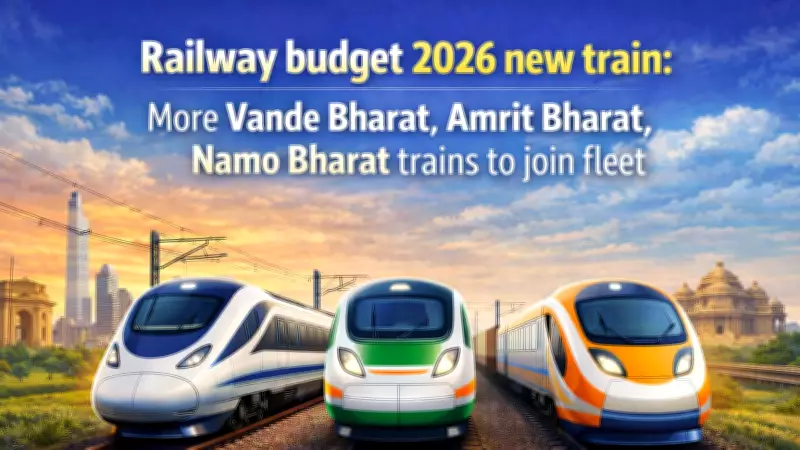
Railway Budget 2026 Unveils Major Train Fleet Expansion Plan
In a significant announcement that promises to transform India's rail connectivity, Railway Minister Ashwini Vaishnaw has revealed ambitious plans for expanding the country's premium train fleet. The Ministry of Railways is set to introduce a substantial number of new Vande Bharat, Amrit Bharat, and Namo Bharat trains during the financial year 2026–27, marking a major leap forward in passenger rail services.
Comprehensive Fleet Enhancement Strategy
Addressing a press conference at Rail Bhawan on Sunday, February 1, Minister Vaishnaw outlined the comprehensive expansion strategy that includes multiple variants of the popular Vande Bharat trains. The plan encompasses both Sleeper and Chair Car versions of Vande Bharat trains, alongside the introduction of Amrit Bharat and Namo Bharat services. This multi-pronged approach aims to cater to diverse passenger needs while enhancing overall rail infrastructure.
The union minister confirmed that manufacturing of these advanced trains is already in progress, with production facilities operating at unprecedented capacity. "Manufacturing of Vande Bharat sleeper and chair car trains, Amrit Bharat and Namo Bharat trains, along with record induction of wagons, is progressing at an unprecedented pace," Vaishnaw stated during the announcement.

Record Capital Allocation for Railway Development
The expansion plans are backed by the highest-ever budgetary allocation for Indian Railways. The central government has allocated a total capital expenditure of Rs 2,93,030 crore for the Ministry of Railways in the Union Budget for 2026–27, with an actual outlay of Rs 2,78,030 crore approved in Budget 2026.
According to official statements from the Ministry of Railways, "Backed by the substantial allocation of Rs. 2,78,000 crore in the Union Budget this year, Railways is focusing its spending on high-speed connectivity, freight and safety." The ministry further emphasized that "This is the highest-ever capex as well as allocation for Indian Railways," highlighting the government's commitment to railway modernization.
Vande Bharat Sleeper Train Production Details
Following the successful introduction of 16-coach Vande Bharat Sleeper trains, the national transporter is advancing to the next phase of production. The Chennai-based Integral Coach Factory (ICF) is currently manufacturing 24-car Vande Bharat Sleeper rakes, with plans to produce a total of 50 such advanced rakes. This represents a significant scaling up of manufacturing capacity for premium sleeper services.
In addition to the sleeper variants, the railway ministry is also progressing with the production of Vande Bharat Chair Car trains, which will provide enhanced comfort for daytime travelers. The simultaneous development of multiple train types demonstrates a holistic approach to improving India's rail network.
Broader Manufacturing and Infrastructure Push
Minister Vaishnaw also highlighted the broader manufacturing efforts supporting this expansion, revealing that 17,000 coaches are currently under production and will be added to the railway network in a phased manner. This massive manufacturing initiative underscores the scale of India's railway modernization program and its potential impact on both passenger experience and industrial growth.
The comprehensive approach includes not just passenger trains but also significant investments in freight infrastructure, with record induction of wagons planned alongside the premium train services. This balanced development strategy aims to strengthen both passenger and freight capabilities of Indian Railways.
The announcement comes as part of a broader focus on safety, rolling stock enhancement, new line development, and electrification within the Railway Budget 2026 framework. With these substantial investments and manufacturing initiatives, Indian Railways appears poised for a transformative period that could significantly improve connectivity and travel experience across the nation.






