

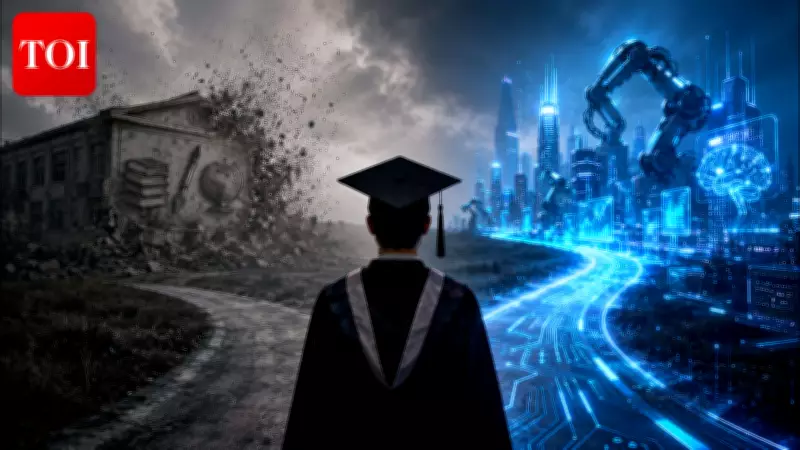
China is rewriting what its students are allowed to study. Between 2021 and 2025, the country's universities scrapped or suspended 12,200 undergraduate degree programmes and rolled out 10,200 new ones, according to Ministry of Education data cited by Xinhua. That churn touched more than 30 per cent of all university programmes nationwide, and the logic behind it is blunt: degrees that don't lead to jobs are being treated as dead weight. The cuts have fallen hardest on arts, humanities, foreign languages and management, the South China Morning Post reported, while the new additions lean almost entirely toward AI and other tech-focused fields.
Why arts and humanities degrees are being cut first
The fields getting axed share a common problem: too many graduates, too few jobs, and now AI eating into the work itself. The University of Shanghai for Science and Technology halted admissions for its product design programme this year. One recent graduate told the SCMP the call was tied partly to grim employment prospects, adding that AI has hit the field hard since core tasks like modelling and rendering can now be handled by software. Even prestigious schools are consolidating. The Communication University of China, a top media school in Beijing, merged its cinematography programme into a broader film and television production track. Alumni mostly shrugged it off as overdue. Song Song, who finished CUC's cinematography course in 2012, pointed to live streaming and short video as proof that what a cameraman needs to know today barely resembles the old playbook.
How China is steering students toward AI and robotics
Many of the new programmes map directly onto Beijing's economic priorities. Nine universities have added majors in embodied intelligence, lining up with a national push to fold next-generation AI into the real economy. The demand is real: recruitment platform Zhilian Zhaopin reported listings for AI product managers jumped 81 per cent year on year, while platform Maimai clocked a 369 per cent surge in the same role. Beijing is pairing the curriculum reshuffle with a retraining drive. The Ministry of Human Resources and Social Security pledged to upskill 1 million young people this year in AI, advanced manufacturing, the low-altitude economy and new energy vehicles. Some cities have gone further, the SCMP reported, with Beijing launching six full-time technical programmes that pair a year of classroom study with a year-long internship for college graduates, an idea that has drawn online scepticism from students who question why a degree should land them back in vocational school.

Whether swapping majors actually fixes the problem
Not everyone is convinced the reshuffle gets to the root of things. Chu Zhaohui, a senior researcher at the National Institute of Education Sciences, noted that many of the freshly cut programmes were themselves created only a few years ago during an earlier overhaul, leaving little time to mature. Rather than endlessly swapping one major for another, he argued universities should give students more freedom to pick their own courses and build a distinctive profile. That sentiment is filtering down to families. Vincent Zhao, a 48-year-old who runs a Beijing media production company, steered his daughter toward statistics and data governance when she started university last year, picking a broad direction over a narrow specialism. As he put it to the SCMP, the old path of one major, one matched job, and a stable career for life simply doesn't exist any more. For now, the message from China's classrooms is clear enough. The degree that looked safe a decade ago may not survive the next round of cuts, and students are being nudged to plan accordingly, treating a bachelor's as a starting line rather than a finish.






