

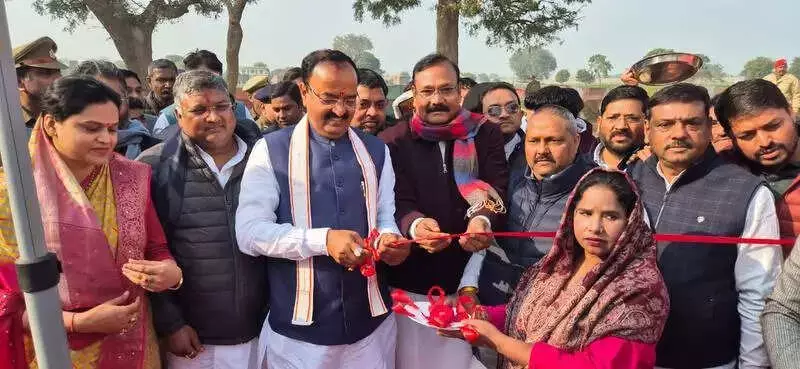
Uttar Pradesh Deputy Chief Minister Keshav Prasad Maurya presented a comprehensive blueprint for rural transformation on Friday, detailing the provisions of the newly enacted Viksit Bharat Guarantee for Rozgar and Ajeevika Mission (Gramin) Act, 2025. Branded as VB-G RAM G, the legislation was described by Maurya as a concrete roadmap for developing villages, the state, and the nation as a whole.
Key Provisions and Enhanced Guarantees
Addressing a press conference in Agra, the deputy chief minister outlined the Act's core components. A significant enhancement is the increase in guaranteed rural employment from 100 to 125 days per year. Maurya stated that this framework is designed to benefit nearly 70% of the population, strengthening village-level infrastructure while ensuring dignity, social security, and timely weekly wage payments for workers.
He positioned the scheme as a symbol of Indian culture, good governance, and public welfare. Elaborating on the acronym, Maurya explained: G stands for Jan Bhagidari (public participation), Ra for Rashtra Nirman (nation building), M for Manviya Moolyon ke saath Vikas (development with human values), and Ji for Jan Kalyan (public welfare).

Tech-Driven Transparency and Expanded Work Scope
The Act mandates a robust technological backbone to enhance efficiency and curb corruption. Job cards will be issued for a three-year validity, and the government plans to deploy biometric systems, GIS-based mobile applications, and face-recognition technology for authentication and monitoring.
Village panchayats will be graded into A, B, and C categories based on development indicators, and planning will utilize the PM Gati Shakti platform, GIS, and other IT tools. Maurya assured that existing MGNREGA staff would continue under the new Act.
The scope of permissible works has been expanded beyond traditional projects. It will now include:
- Construction of kitchen sheds and laboratories in schools.
- Building boundary walls.
- Undertaking disaster management works.
Maurya emphasized that these measures, combined with sustained local employment, aim to reduce distress migration and build a "corruption-free, self-reliant and modern rural India."
Gram Chaupal Address and Lakhpati Didi Target
Later, at a gram chaupal in Paitikheda village of Agra district's Fatehabad tehsil, Maurya reiterated the vision of bridging the urban-rural divide. He promised that villages would soon match cities in critical infrastructure like roads, drainage, and water management.
He also highlighted the state government's ambitious target of creating three crore Lakhpati Didis (women millionaire entrepreneurs). Noting that one crore women have already been certified and honoured under the initiative, Maurya expressed confidence that each village would eventually have 10 to 20 such successful women entrepreneurs.
The event, however, faced a brief interruption due to a power outage. Deputy CM Maurya directed strict action against those responsible, prompting District Magistrate Arvind Mallappa Bangari to order an immediate inquiry into the incident.






