

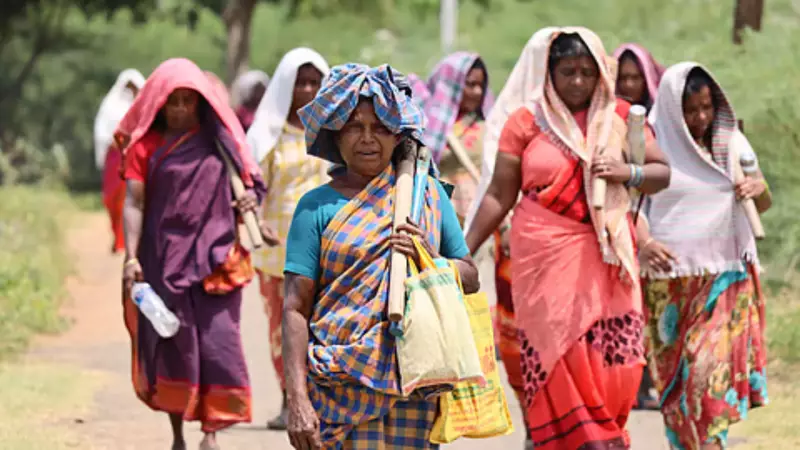
A major analysis by the State Bank of India (SBI) has projected that the newly passed Viksit Bharat Guarantee for Rozgar and Ajeevika Mission (VB-G RAM G) Act will provide a significant financial boost to states. According to the report, states are expected to be collective net gainers of nearly Rs 17,000 crore compared to the average allocations over the past seven years.
Debate Over Funding Structure Addressed
The legislation, which was passed by Parliament in the recent winter session and received Presidential assent from Droupadi Murmu on December 21, had sparked debate. A key point of contention was the shift in the Centre-state funding ratio to 60:40 for general category states. North-Eastern states, Union Territories, and Himalayan states remain exempt from this revised ratio.
Critics had expressed concerns that this change might place a higher financial burden on states, potentially weakening their finances or pushing them towards increased borrowing. However, the SBI report argues these apprehensions are "misplaced and largely emerging from misunderstanding of state funding." It states that an objective evaluation shows an improvement in overall fund distribution.

Normative Assessment Reveals State Gains
The SBI's assessment is built on seven parameters focused on equity and efficiency. It involved a simulated, normative calculation based purely on the central government's share. The bank compared each state's projected share under the new Act to the average allocations under the Mahatma Gandhi National Rural Employment Guarantee Act (MGNREGA) between FY19 and FY25, excluding the anomalous FY21.
"We estimate the States gain around approx. Rs 17,000 crores when compared to average allocation of last 7 years, hinting at a scenario where most of the states will be net gainers," the SBI report concluded. The analysis found that only two states recorded marginal losses in the aggregate comparison.
State-Wise Winners and Future Potential
The report predicts that Uttar Pradesh and Maharashtra will see the biggest gains under the proposed VB-G RAM G framework. They are followed by Bihar, Chhattisgarh, and Gujarat in terms of financial benefit.
In the case of Tamil Nadu, which showed a marginal loss, SBI clarified that if the outlier high allocation of FY24—which was 29% above the FY22-FY23 average—is excluded, the loss becomes negligible. The report emphasizes that adopting objective criteria strengthens devolution for both developed and lagging states, maintaining a balance between equity and efficiency.
Furthermore, SBI highlighted that states have a clear opportunity to further scale up their benefits by effectively utilising their 40% contribution under the new funding pattern. This proactive approach could lead to even better outcomes for rural employment and livelihood missions.
Expanded Employment Guarantee
The core provision of the VB-G RAM G Act is an enhanced employment guarantee. It raises the guaranteed wage employment from 100 days to 125 days per rural household annually for adult members willing to do unskilled manual work. This expansion forms the backbone of the mission's goal to boost rural livelihoods and employment.
The passage of this Bill marks a significant shift in India's rural employment guarantee framework, with the SBI report providing a data-driven counterpoint to initial concerns about state finances.






