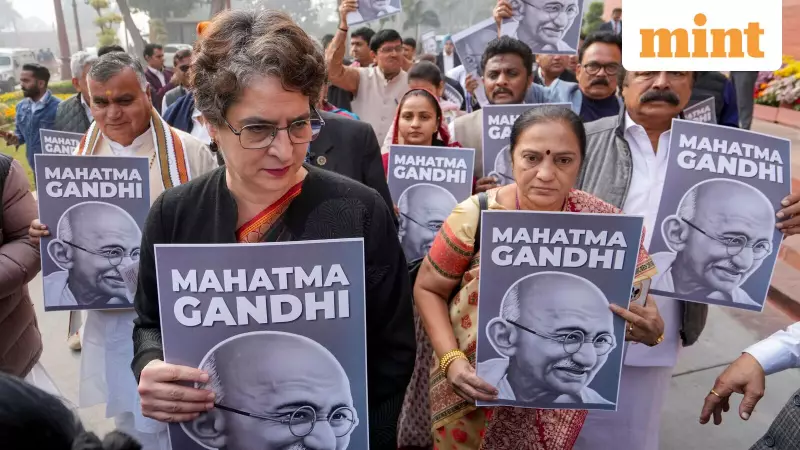
In a significant policy shift, President Droupadi Murmu on Sunday granted her assent to a new legislation that overhauls India's flagship rural jobs scheme. The Viksit Bharat Guarantee for Rozgar and Ajeevika Mission (Gramin) Bill, now an Act, formally replaces the nearly two-decade-old Mahatma Gandhi National Rural Employment Guarantee Act (MGNREGA) of 2005.
Key Changes in the New Rural Employment Law
The newly minted VB-GRAM G Act introduces several fundamental changes to the structure and implementation of rural wage employment guarantees. The most prominent change, beyond the omission of Mahatma Gandhi's name which has drawn criticism from opposition parties, is the enhancement of the statutory guarantee itself.
The law now guarantees 125 days of wage employment per financial year for adult members of rural households willing to do unskilled manual work. This marks an increase from the 100 days provided under the previous MGNREGA framework.

Funding and Administrative Overhaul
A major structural shift concerns the funding model. Under Section 22 of the VB-GRAM G Act, the financial burden will now be shared between the central and state governments. The general fund-sharing ratio is set at 60:40, with the Centre contributing 60% and states providing 40%.
However, a special provision exists for certain regions. For North Eastern states, Himalayan states, and the Union Territories of Uttarakhand, Himachal Pradesh, and Jammu & Kashmir, the funding pattern will be a more favourable 90:10. This is a departure from the MGNREGA model, where the wage component was entirely funded by the central government.
The administrative body managing the scheme has also been changed. While MGNREGA fell under the purview of the Rural Development Ministry, the VB-GRAM G scheme will be overseen by a newly constituted Central Gramin Rozgar Guarantee Council.
Operational Modifications and Penalties
The new law introduces a 60-day pause in the scheme during peak agricultural seasons of sowing and harvesting. This provision is aimed at ensuring the availability of labour for critical farming activities.
Furthermore, the penalty for violations of the Act's provisions has been increased substantially. The fine has been raised tenfold, from the previous amount of ₹1,000 to a steeper ₹10,000.
All works under VB-GRAM G will originate from Viksit Gram Panchayat Plans. These plans will be consolidated at the Block, District, and State levels, and ultimately aggregated into a national framework known as the Viksit Bharat National Rural Infrastructure Stack.
The enactment of this law marks a pivotal moment in India's social security architecture for rural workers, promising more days of work but also introducing a new era of cooperative federalism in its funding and execution.