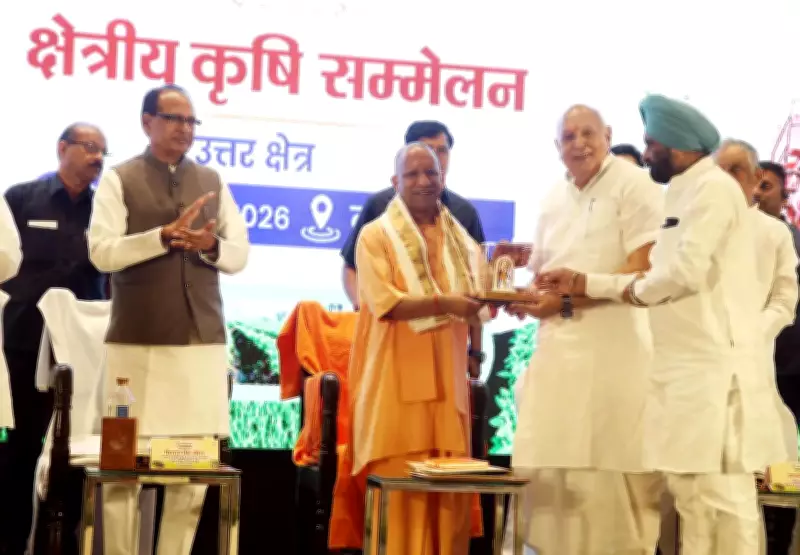
Lucknow: Chief Minister Yogi Adityanath on Friday stated that Uttar Pradesh's progress in agricultural production is the result of scientific techniques, agro-climatic zone-based strategies, and coordinated efforts between the central and state governments.
Addressing the Regional Agriculture Conference
Speaking at the Regional Agriculture Conference (North Zone) in Lucknow, Yogi emphasized that the "Lab to Land" concept has been effectively implemented on the ground in Uttar Pradesh, directly benefiting farmers.
"There has been a significant rise in the agricultural growth rate, record improvement in per-hectare productivity, expansion of multi-cropping practices, and increased focus on value addition," he said, adding that Uttar Pradesh now has the potential to give a new direction to the country's agricultural economy.

Agro-Climatic Zone-Based Policies
The Chief Minister noted that since different countries and regions have distinct agro-climatic zones, policies should be designed accordingly. He highlighted that innovation is now being directly implemented at the practical level for the first time.
"Earlier, research conducted in laboratories used to take a long time to reach the fields, but now the 'Lab to Land' concept has become a reality, with technology reaching farms directly," he said, expressing gratitude to Union Agriculture Minister Shivraj Singh Chouhan for playing a significant role in implementing the concept across the country.
Yogi further remarked that earlier, policies remained confined to formal events. "But now, tangible results are visible. If farmers are provided with accurate information about schemes, they themselves are capable of achieving better outcomes," he said.
Revitalization of Krishi Vigyan Kendras
Referring to the situation in 2017, he noted that the state then had only 69 Krishi Vigyan Kendras (KVKs), most of which were nearly inactive, with their scientists attached to other institutions. Subsequently, with the central government's initiative to establish 20 new KVKs and strengthen existing ones, a structured plan was implemented.
"Today, all KVKs are active, promoting innovation and driving agricultural development across all nine agro-climatic zones of the state through Centres of Excellence," he said.
Direct Implementation and Growth
Yogi noted that scientists today conduct demonstrations at the local level and then implement them directly in farmers' fields through regular visits, continuous workshops, and various outreach programmes, while maintaining constant dialogue with the Government of India.
"As a result, the agricultural growth rate of Uttar Pradesh has increased from 8% to approximately 18%," he said.
The Chief Minister emphasized that greater achievements are possible. He noted that at the time of Independence, agriculture contributed about 41-42% to India's economy, but this share has gradually declined. If better coordination is established between agriculture and manufacturing, the pace of development can accelerate further.
Role of Technology and International Institutes
Yogi underscored that technology can play a crucial role in the present era. He expressed gratitude to the Government of India and Prime Minister Narendra Modi for facilitating the establishment of international centres for various products in the state.
For example, the International Rice Research Institute has been set up in Varanasi, yielding excellent results with the development of new crop varieties. He also thanked the PM for approving the International Potato Center in Agra, which is set to begin operations soon.
Based on different agro-climatic zones, suitable crop varieties, appropriate technologies, and the role of quality seeds in increasing production are now clearly evident. He noted with satisfaction that in some areas, paddy yield has reached up to 100 quintals per hectare, compared to 50-60 quintals earlier.
Continuous Efforts Needed
He said that despite this, continuous efforts are needed to reduce costs, increase production, ensure the timely availability of quality seeds, minimize the use of chemical fertilizers and pesticides, and promote natural farming practices.

Yogi said that the impact of the Centre's schemes is clearly visible in Uttar Pradesh. In many districts, farmers are now producing three crops a year. He said around 85-86% of the state's land is irrigated, connectivity has improved, and farmers receive 10-12 hours of electricity, creating a favourable environment for agriculture.
The Chief Minister concluded that government efforts, such as providing seeds, disseminating information, and establishing procurement centres, have yielded positive results. Farmers are now receiving fair prices for their produce, boosting their confidence.