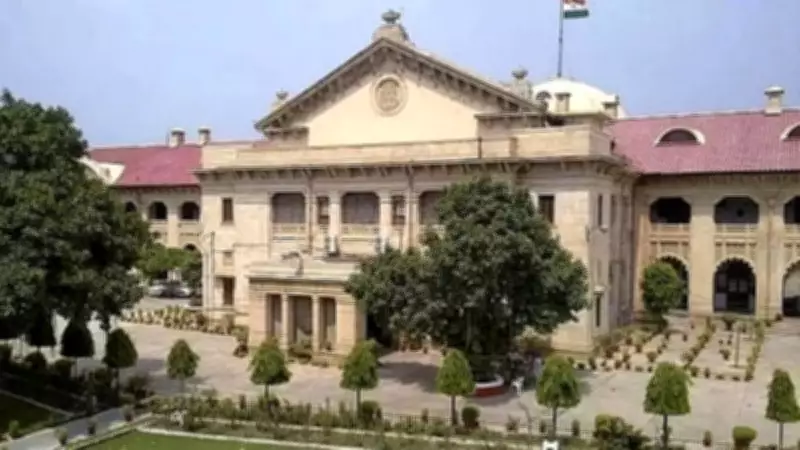
The Allahabad High Court on Monday directed the Union government and the Archaeological Survey of India (ASI) to file a counter-affidavit in the ongoing 'Tejo Mahalaya' dispute, where a group of petitioners claims that the iconic Taj Mahal was originally a Hindu temple dedicated to Lord Shiva. The petition, filed on July 3 by the Agreshwar Mahadev Nagnatheswar Virajman Tejo Mahalaya temple, along with advocate Hari Shankar Jain and four others, seeks recognition of the Taj Mahal as a temple and demands the right to worship there.
Background of the dispute
The 'Tejo Mahalaya' theory, propagated by some historians and activists, asserts that the Taj Mahal was built over an ancient Shiva temple known as Tejo Mahalaya. The petitioners argue that the monument was originally a Hindu structure and that the Mughal emperor Shah Jahan only modified it. They have demanded that the ASI allow Hindu prayers inside the Taj Mahal, which is currently a UNESCO World Heritage Site and a protected monument under the ASI's care.
Court's directive
Hearing the matter, a division bench of the Allahabad High Court comprising Justice Ashwani Kumar Mishra and Justice Dr. Yogendra Kumar Srivastava issued notices to the Union Ministry of Culture, the ASI, and the Uttar Pradesh government, asking them to file their counter-affidavits within four weeks. The court also directed the petitioners to serve copies of the petition to all respondents. The next hearing is scheduled for August 2026.

According to the petitioners' counsel, Hari Shankar Jain, the Taj Mahal's original name was Tejo Mahalaya and it was a place of worship for Hindus. “We have submitted historical evidence and architectural proofs that the monument was a Shiva temple before Shah Jahan seized it,” Jain said. The petition also cites the discovery of a Shivling and other Hindu symbols in the basement of the Taj Mahal, which the ASI has previously denied.
Impact and reactions
The case has reignited debates over the origins of the Taj Mahal, a symbol of love and a major tourist attraction. The ASI has consistently maintained that the Taj Mahal is a Mughal-era mausoleum built by Shah Jahan for his wife Mumtaz Mahal. Historians and archaeologists have dismissed the Tejo Mahalaya theory as lacking credible evidence. The court's decision to seek a response from the authorities indicates that it will examine the claims seriously.
The petitioners have also sought a stay on the entry of non-Hindus into the monument until the matter is resolved, which could have significant implications for tourism and religious harmony. The Uttar Pradesh government has not yet commented on the development. The case is being closely watched by historians, religious groups, and the tourism industry.