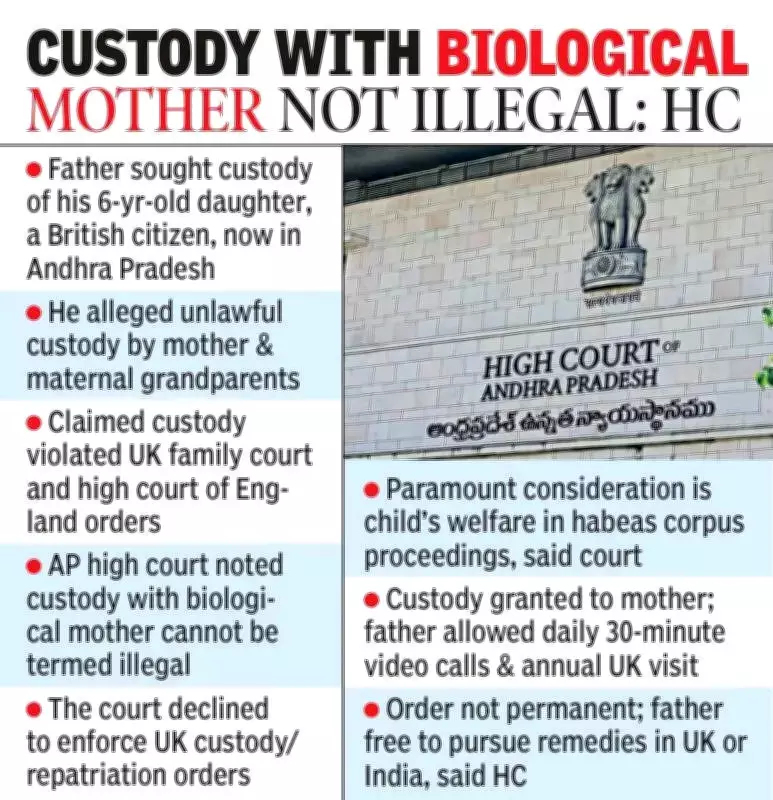
AP High Court Rejects UK Custody Orders, Prioritizes Child Welfare in Landmark Ruling
In a significant judgment with international implications, the Andhra Pradesh High Court has firmly declined to enforce custody and repatriation orders issued by courts in the United Kingdom. The court's ruling establishes a clear precedent that foreign court directives are not binding on Indian judicial authorities and cannot supersede the paramount consideration of a child's welfare in habeas corpus proceedings.
Case Background: Father's Petition for Custody
A division bench comprising Justices Cheekati Manavendranath Roy and Tuhin Kumar Gedela dismissed a writ petition filed by a father seeking custody of his six-year-old daughter, who holds British citizenship by birth. The petitioner had approached the high court alleging that his daughter was being held in unlawful custody by her mother and maternal grandparents in Andhra Pradesh.
The father sought directions to produce the child before the court and argued that the custody arrangement with the mother violated multiple orders previously issued by the family court at Kingston-upon-Hull and the High Court of England. He presented these foreign court orders as grounds for immediate intervention by the Indian judiciary.

Court's Reasoning: Welfare Over Foreign Directives
The Andhra Pradesh High Court delivered a comprehensive rejection of this argument, observing that custody with the biological mother cannot be deemed illegal under the circumstances. The bench noted that the father had himself admitted on record that he had voluntarily handed over the child to the grandparents, undermining his claim of unlawful detention.
In its detailed judgment, the high court emphasized that a writ of habeas corpus cannot be converted into an execution mechanism for enforcing foreign court orders. The bench articulated that Indian courts maintain independent jurisdiction and are not obligated to implement directives from foreign judicial systems, particularly when such implementation might conflict with domestic legal principles and the best interests of the child.
Doctrine of Parens Patriae and Child Welfare Considerations
Central to the court's decision was the application of the doctrine of 'parens patriae,' which positions the state as the ultimate protector of citizens who cannot protect themselves, particularly minors. The bench stressed that welfare considerations assume heightened significance in cases involving minor children, especially young girls.
The court examined multiple factors affecting the child's wellbeing, including emotional security, biological needs, and consistent caregiving. These considerations gained particular weight given the father's own admission that he lives alone in the United Kingdom and requires hired help for childcare responsibilities. The bench determined that these practical realities could not be ignored when assessing what arrangement would best serve the child's interests.
Balanced Resolution and Future Proceedings
While granting custody to the mother, the high court implemented measures to maintain the father-child relationship. The bench ordered daily video interactions of thirty minutes between father and daughter and permitted the child to travel to the United Kingdom once annually until she reaches the age of majority.
The court clarified that its custody order does not represent a permanent settlement of the matter. The ruling remains subject to future proceedings under applicable law, and the father retains the right to pursue further remedies before competent courts in either the United Kingdom or India. The bench explicitly stated that its present decision is confined strictly to the scope of habeas corpus jurisdiction and does not preclude other legal avenues.
This landmark judgment reinforces the autonomy of Indian courts in family law matters involving international elements and establishes child welfare as the non-negotiable priority in custody determinations, regardless of foreign judicial opinions.