

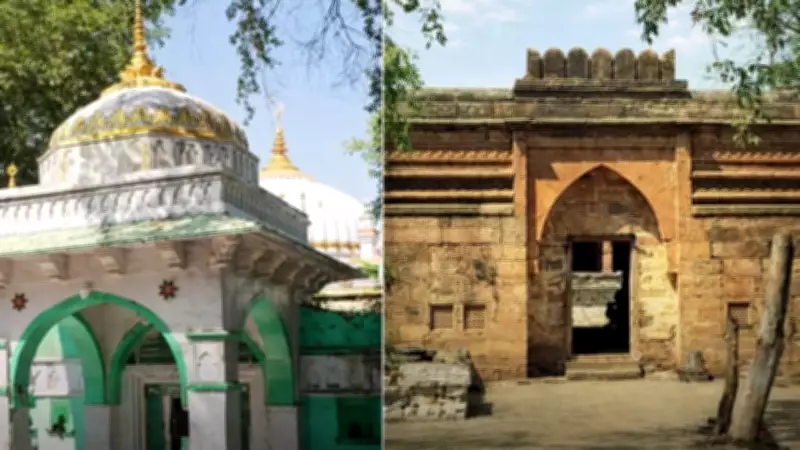
Hindu Front Presents ASI Evidence in Bhojshala Dispute Before MP High Court
The Hindu Front for Justice presented arguments before the Madhya Pradesh High Court on Thursday, asserting that documents from the Archaeological Survey of India, including its comprehensive scientific survey report, substantiate their claim that a temple predated the mosque at the contested Bhojshala complex in Dhar district.
Background of the Bhojshala-Kamal Maula Mosque Complex
The Bhojshala complex has long been a focal point of religious contention. Hindu groups regard it as a temple dedicated to Vagdevi, the goddess Saraswati, while the Muslim community identifies it as the Kamal Maula mosque. This dispute has spawned numerous petitions and a writ appeal concerning the site's religious character, with the Indore bench of the High Court conducting day-to-day hearings since April 6.
In its public interest litigation, the Hindu Front for Justice contends that an 11th-century temple honoring Goddess Saraswati originally occupied the site. They allege that following the temple's demolition, its remnants were repurposed in the construction of a mosque.

Legal Arguments and ASI Report Submission
On the fourth day of proceedings, advocate Vishnu Shankar Jain, representing one of the petitioners, concluded his submissions before a division bench comprising Justices Vijay Kumar Shukla and Alok Awasthi. Jain argued that historical evidence confirms the existence of a Saraswati temple at the location.
Jain asserted that Muslim rulers, motivated by opposition to idol worship, dismantled the Hindu place of worship and utilized its materials to erect a mosque at the complex. To bolster this argument, he referenced the ASI's 2024 scientific survey report, which was prepared pursuant to the High Court's directive, along with the agency's affidavits, replies, and historical documents published in 1902 and 1904.
Jain emphasized that the ASI's findings, grounded in the site's actual physical condition, align with the petitioners' case. "This does not mean that the ASI is taking sides. The ASI is only placing facts on record based on what exists at the site," he clarified to the court.
Objections from Opposing Counsel
During the hearing, Jain detailed portions of the scientific survey report, which reportedly enumerates evidence such as religious symbols, Sanskrit inscriptions, and idol remnants indicative of a temple. However, this prompted objections from opposing legal representatives.
A senior lawyer for the Central government contended that it is the ASI counsel's responsibility to present and elucidate the survey's findings in court. Simultaneously, counsel for an intervenor from the Muslim side objected, arguing that petitioners cannot legally rely on documents from a respondent like the ASI to support their case.
After deliberating on these objections, the High Court permitted Jain to highlight specific relevant sections of the ASI report. The ASI operates under the Union Ministry of Culture.
Details of the ASI Scientific Survey
The High Court had ordered the ASI to conduct a scientific survey of the Bhojshala-Kamal Maula mosque complex on March 11, 2024. The survey commenced on March 22, 2024, and culminated in a report submitted on July 15, 2024, following a 98-day investigation.
The extensive report, spanning over 2,000 pages, suggests that a substantial structure from the Paramara period, which spanned the 9th to 13th centuries, existed at the site prior to the mosque's construction. It further indicates that components of temples were reused within the current complex.
In response, the Muslim side has challenged the validity of the ASI survey and dismissed the Hindu claim of an original temple. They have alleged that certain materials incorporated into the survey were "introduced from the backdoor," casting doubt on the findings' integrity.
The ongoing legal battle underscores the deep-seated historical and religious tensions surrounding the Bhojshala complex, with both sides steadfastly presenting their interpretations of the archaeological evidence.






