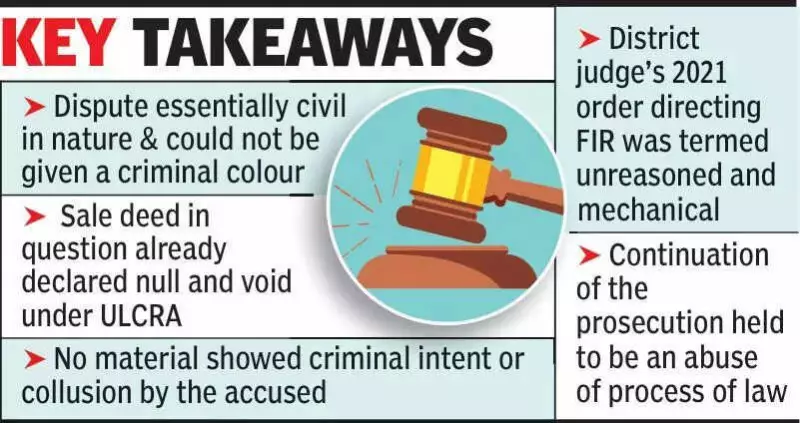
The Nagpur bench of the Bombay High Court has thrown out a criminal case related to a decades-old land dispute, strongly criticising the inordinate delay in filing the First Information Report (FIR). The court stated that pursuing the prosecution would be an abuse of the legal process.
Court Halts Proceedings in Long-Running Property Row
A division bench comprising Justices Urmila Joshi-Phalke and Nandesh Deshpande allowed a criminal application filed by 14 members of a Nagpur-based family and their employees. Their lawyer, Ritesh Badhe, represented them. The bench's order sets aside the FIR registered at Ajni police station on February 10, 2021, the chargesheet filed in 2025, and all related criminal proceedings pending before the additional chief judicial magistrate.
The case originated from a complex property transaction involving land at Mouza Babulkheda in Nagpur. Competing claims by cooperative housing societies, stretching back over forty years, were at the heart of the dispute. The FIR had accused the petitioners of fraudulently selling a piece of land to which they allegedly had no valid title.

The Core Issue: A Sale Deed Declared Void Decades Ago
Delving into the history, the High Court identified the crux of the matter in a sale deed executed in 1982. This deed was in favour of the Manav Seva Cooperative Housing Society but curiously used a registration number belonging to a different society that was already in the process of being wound up.
The judges noted that the competent authority under the Urban Land (Ceiling and Regulation) Act, 1976, had declared this 1982 sale deed null and void in 1988. This decision was later confirmed by the collector in 1991. The bench pointed out that the allegations in the FIR itself stated that the purported offences occurred between January 1992 and January 1998.
"Highly Belated" FIR Casts Doubt on Credibility
The court found the timing of the FIR to be critically flawed. It was lodged only in February 2021, years after the alleged events. The bench termed this a "highly belated" complaint, which seriously undermined its credibility.
"Inordinate delay can be an aspect which would be considered while appreciating rival contentions," the judges observed. They referred to Supreme Court precedents, stating that an unexplained delay of such a large magnitude could be fatal to a criminal prosecution.
The court also concluded that the allegations in the FIR and the sale deed did not constitute any offence, primarily because the sale deed had already been declared legally invalid in 1988. Furthermore, the bench was critical of a 2021 order by a district judge that had directed the registration of the FIR. It called that order "totally unreasoned" and passed mechanically without examining the factual background.
In its final ruling, the High Court asserted that continuing the criminal proceedings against the petitioners would cause serious injustice and firmly reiterated that it amounted to an abuse of the process of law.