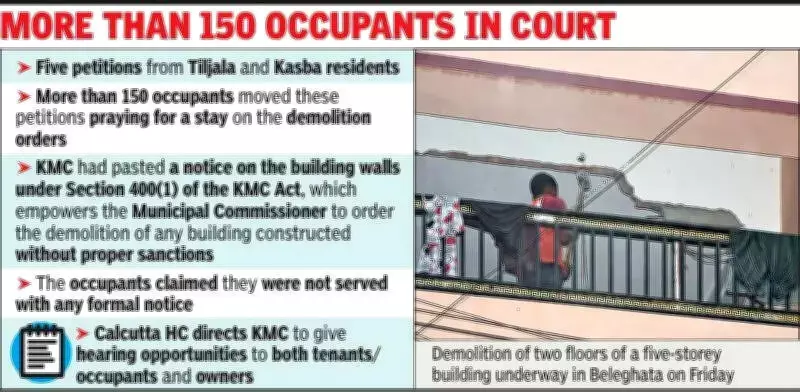
The Calcutta High Court on Friday stayed demolition notices served to multiple buildings in Tiljala and Kasba for the next 30 days. The court directed the Kolkata Municipal Corporation (KMC) to provide a hearing not only to the owners of the unauthorised buildings but also to the occupants and tenants.
Court's Directive on Hearing
In a significant ruling, the High Court held that 'in case of a demolition notice for unauthorised constructions, a hearing opportunity should be given to both tenants/occupants and building owners.' The court ordered that status quo be maintained in a series of cases challenging KMC's demolition orders. The KMC commissioner was directed to give an opportunity of hearing to the tenants and occupants of these premises within 30 days.
Petitions Challenging Demolition Orders
Around five petitions, representing premises with more than 150 occupants, challenged the KMC's demolition orders before the vacation bench of Justice Shampa Dutt (Paul). The primary contention of the petitioners was that the KMC had simply pasted a notice on the building walls under Section 400(1) of the KMC Act. This section empowers the municipal commissioner to order the demolition of any building constructed without proper sanctions. The occupants themselves were not served with any formal notice.

Arguments by the State
The state, represented by additional advocate general Billwadal Bhattacharyya, questioned the maintainability of the petitions. He argued that the petitions contained no averments stating that the premises in question were 'sanctioned' buildings. The state further submitted that serving individual notices to every occupant of a premises is not practically possible.
Senior advocate Bikash Ranjan Bhattacharyya challenged the manner in which these notices had been issued. He contended that these buildings have been standing in the areas for years. 'Is it not an implied sanction?' Bhattacharyya argued.
Court's Observations and Ruling
Initially, Justice Dutt (Paul) remarked that the court would not stay the demolition orders but maintained that an opportunity of hearing must be given to the occupants. Subsequently, senior advocate Bhattacharyya relied on an order passed by a single bench of Justice Raja Basu Chowdhury on May 15 regarding a Tiljala building demolition. In that case, a ground-floor manufacturing unit had caught fire, leading to the deaths of two workers.
However, the present case was slightly different. While the building in the May 15 order had already been partially demolished by the KMC before the case reached the court, no demolition had taken place in this case; only notices under Section 400(1) had been issued.
Nevertheless, Justice Dutt (Paul) held that the notices in this case were issued on 'very short notice'. 'The writ petitioners will appear before the authorities concerned within 30 days. The order will have to be served to both occupants and owners,' the judge held.
To maintain parity with the HC's previous ruling, status quo was directed to be maintained. The municipal authorities, in consultation with the occupants, shall remove any dangerous portions. However, the question of maintainability has been kept open by the high court.