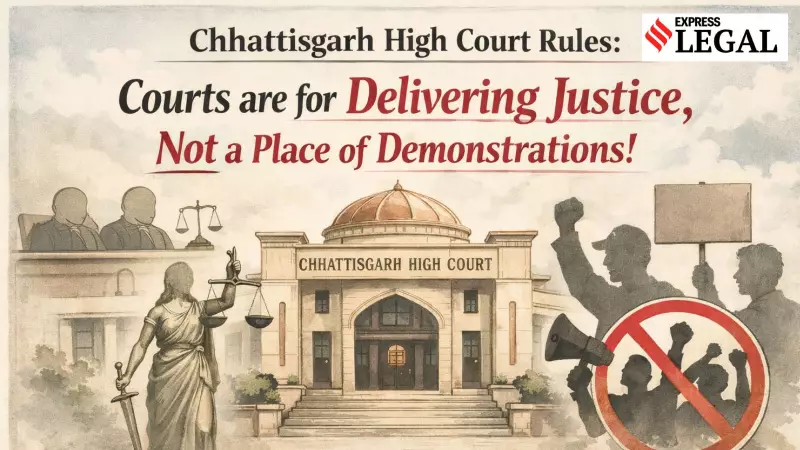
Chhattisgarh High Court Upholds Judicial Sanctity, Denies Bail in Courtroom Disruption Case
The Chhattisgarh High Court made a strong statement this week. It denied anticipatory bail to two men accused of storming a courtroom. The court emphasized that courts are sacred spaces for justice. They are not venues for protests or demonstrations.
Court's Firm Stand on Neutrality and Dignity
Chief Justice Ramesh Sinha heard the bail plea. He observed that court premises must remain neutral and dignified. These are inviolable spaces dedicated solely to administering justice. The court said no protests or public agitations should occur there.
The ruling stated clearly that allowing such acts would erode public confidence. It would encourage lawlessness. The court stressed that no individual or group can take the law into their own hands. This is especially true when intimidation or obstruction of public servants is involved.

Details of the Alleged Incident
The case stems from an incident in Bilaspur. A religious storyteller, Ashutosh Chaitanya, was arrested in November 2025. He faced charges for allegedly making derogatory remarks against the Satnami community.
Police escorted him to a trial court. At that time, a mob unlawfully gathered within the court premises. The mob allegedly entered the courtroom. They raised slogans and threatened the accused. They also manhandled police personnel and disrupted judicial proceedings.
An FIR was registered under various sections of the Bharatiya Nyaya Sanhita. The charges included rioting, obstructing public servants, and outraging religious feelings. The two applicants then moved the High Court seeking anticipatory bail.
Arguments Presented by Both Sides
The defense counsel argued the applicants were innocent. They claimed the men were near the court for personal work. They did not participate in any protest or slogan-raising. The defense called the FIR a "counter-blast" lodged under political pressure.
They also relied on video footage. They asserted the recordings would show the applicants were not present or involved. The applicants promised to cooperate with the investigation.
The state's counsel presented a different picture. They argued the applicants actively participated in the unlawful assembly. They manhandled police officials and obstructed their duties. The prosecution noted one applicant had six criminal antecedents. The other had at least one prior criminal case. They argued the men did not deserve anticipatory bail.
Court's Reasoning for Denying Bail
The court found the allegations very serious. It highlighted several key points:
- Unlawful assembly within court premises disrupts judicial proceedings.
- Such acts threaten the safety of litigants, advocates, officers, and police.
- Condoning these acts would weaken public trust in the justice system.
- Granting bail in such circumstances would send the wrong signal to society.
The court concluded that protecting judicial institutions outweighed the applicants' claim for pre-arrest protection. The bail plea was therefore rejected.
This ruling reinforces the principle that courts must remain hallowed grounds. They are where justice is delivered, not where it is disrupted by mob action.