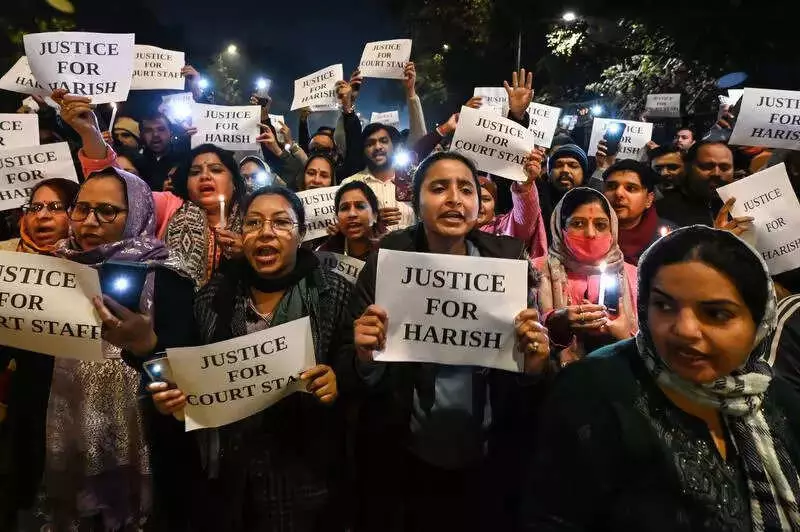
A 43-year-old court clerk, known as an ahlmad, died by suicide on the premises of the Saket Court Complex in New Delhi on Friday morning. The tragic incident has ignited strong protests from fellow court employees, who are pointing to severe work pressure and a chronic shortage of staff within the district judiciary as the root causes.
A Dedicated Worker Pushed to the Brink
The deceased has been identified as Harish Mahar, a 2010-batch ahlmad who was recently promoted and posted to a digital NI (Non-Imagable) court. Colleagues described him as a "jolly" and dedicated worker. Mahar, who was originally from Faridabad, was 60% handicapped due to a hunched back. He is survived by his 94-year-old father.
According to police sources, a note found in his pocket detailed his profound frustration. He wrote about the immense pressure of his work, his repeated but unsuccessful requests for a transfer to a less strenuous posting due to his physical condition, and his feeling of being trapped. "Even if I take early retirement, I shall receive my savings or pension at the age of 60. So suicide is my only option," the note stated. He explicitly mentioned ending his life due to "office work pressure" and that he was acting out of his "own free will," absolving others of responsibility.

Unmanageable Workload and Ignored Pleas
Mahar had been working at the Saket court complex for the last three months following his promotion. Fellow staff members revealed that he was handling an unusually heavy load of approximately 4,000 case files in the court of Judicial Magistrate First Class, Nandini Garg, in the digital traffic court. Ahlmads are responsible for the bulk of clerical and administrative paperwork in a court.
Despite his physical challenges, the job was "very tough" on him, leading to an inability to sleep, as mentioned in his letter. Colleagues stated that Mahar had applied for a transfer at least four times, seeking a posting with a lighter workload, but his requests were never considered by the authorities.
Security personnel reported that Mahar took the drastic step at 10:17 am. He was rushed to PSRI Hospital by 10:24 am, where doctors declared him dead. His body was handed over to the police in the afternoon.
Protests and Calls for Systemic Change
In response to the tragedy, ahlmads and other court staff began a sit-in protest outside the court premises at 11:30 am. The protest underscored the collective anguish and the systemic issues plaguing the judicial support staff.
Dhir Singh Kasana, former secretary of the Saket Court Bar Association, emphasized the need for change, stating, "The system needs to change for the court staff who help in running the courts, and lessen the burden for the judiciary." Many protesters argued that Mahar's death was not an isolated incident but a stark reflection of the immense strain on court employees across the system.
Sanjay Rathi, co-chairman of the Delhi Bar Council, termed the incident "deeply unfortunate." He warned that disproportionate staffing, despite available infrastructure, ultimately hinders the administration of justice. Following the protests, representatives from the Saket court staff union met with Gurvinder Pal Singh, the Principal District and Sessions Judge (South), to voice their concerns and demands for immediate remedial action.