

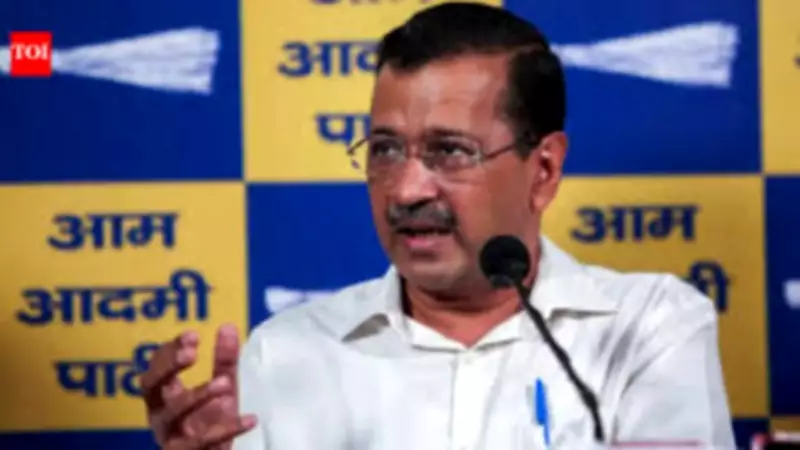
The Delhi High Court on Wednesday dismissed a Public Interest Litigation (PIL) that sought the disqualification of Arvind Kejriwal, Manish Sisodia, and Durgesh Pathak from contesting elections. The court also rejected a demand to de-register the Aam Aadmi Party (AAP). Describing the petition as highly misconceived, the bench refused to entertain the sweeping reliefs sought by the petitioner, according to a report by LiveLaw.
What Was the PIL About?
The petition, filed by Satish Kumar Aggarwal, sought directions against Kejriwal, Sisodia, and Pathak regarding alleged remarks and social media posts targeting Justice Swarana Kanta Sharma. The controversy arose after the judge initiated criminal contempt proceedings against the AAP leaders for their conduct during hearings linked to the Delhi excise policy case. The petitioner argued that such conduct warranted action against the leaders and de-registration of the political party itself.
On What Grounds Did the Court Reject the Plea?
A division bench comprising Chief Justice Devendra Kumar Upadhyaya and Justice Tejas Karia clarified that disqualification of politicians and de-registration of political parties cannot be ordered casually through a PIL unless there are clear legal grounds under election laws. The court further stated that the Election Commission of India (ECI) has no power to review its own order granting registration to a party, making the de-registration prayer legally weak from the beginning.

Can a Political Party Be De-Registered in India?
Under Indian law, political parties are registered with the ECI under the Representation of the People Act, 1951. However, the ECI's power to de-register a party is extremely limited. Relying on the Supreme Court's ruling in Indian National Congress (I) v. Institute of Social Welfare (2002), the Delhi High Court noted that de-registration can be ordered only in three exceptional situations: where registration was obtained by fraud; where the party amends its name in a manner not in conformity with Section 29A(5) of the Act; or where the party intimates the Commission that it has ceased to have faith in the Constitution of India.
The court stated, It is not the case that the party here has got registration due to fraud or that party has amended its nomenclature which are not in conformity with Section 29A (5) or that party here has intimated the Commission that it has ceased to have faith with Constitution of India. The emphasis of counsel for Petitioner is on observations of SC where it has been observed that de-recognition can be done on any like ground where no inquiry is required by ECI. We do not find any such like ground in this petition to attract such situation as said in the judgment. Mere allegations, political controversy, or contempt proceedings do not automatically become grounds for cancellation of a party's registration, the bench added.
When Can Politicians Be Disqualified?
Disqualification of elected representatives is governed by constitutional provisions and election laws. Politicians can face disqualification after conviction in certain criminal cases, findings of corrupt electoral practices, anti-defection violations, or other statutory disqualifications recognized under law. In this case, the PIL did not establish any such statutory ground against the leaders named in the petition. The court observed that even if an individual member of a party scandalizes the court, the appropriate remedy lies under the Contempt of Courts Act, not in the de-registration of the party.
How far are you stretching this provision? If somebody has scandalized the court or proceedings, appropriate remedy is under contempt of court act. If someone is punished under the contempt of court act, will he be disqualified from elections? How will that lead to de-registration of party? First establish that ECI can deregister a party. Your matter does not fall anywhere, the Chief Justice said, as quoted by LiveLaw.
About the Author
The TOI Legal Desk is a dedicated team of journalists committed to tracking and reporting on courts, legal developments, and judicial proceedings across the country and world.






