A 43-year-old differently-abled court employee died by suicide on Friday, jumping from the fifth floor of a building at the Saket Court complex in Delhi. The incident has sparked protests among court staff, who are demanding action against alleged crushing work pressure and severe staff shortages.
A Tragic End Amidst Overwhelming Pressure
Deputy Commissioner of Police (South) Ankit Chauhan confirmed the incident, stating that an investigation is underway. A suicide note was recovered from the pocket of the deceased, identified as Harish Singh Mahar, who worked as an ahlmad, or record keeper. In the handwritten note, Mahar, who described himself as 60% handicapped, wrote that he did not blame anyone but expressed that the job was "very tough" for him and he had succumbed to the pressure.
"I believed I would overcome this but I failed. I am 60% handicapped… this job is very tough for me and I succumbed to the pressure…," the note read, according to police officers. Mahar had been working as court staff since 2010. At the time of his death, he was assigned to a digital traffic court grappling with a staggering pendency of close to 9,000 cases.
Colleagues Mourn, Protest Erupts Demanding Justice
The tragedy unfolded around 10 am when lawyers and other staff near the North Wing Block 1 heard a loud thud. Mahar was rushed unconscious to the PSRI Hospital but was declared dead. His body was later handed over to police for an autopsy at AIIMS.
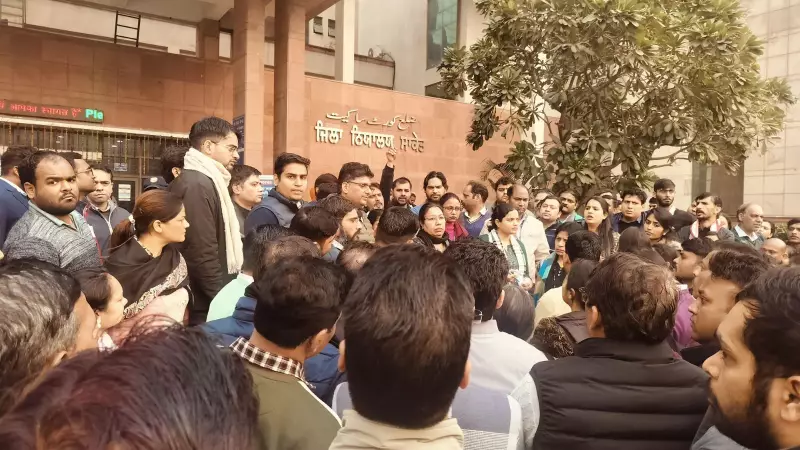
Following his death, court staff gathered outside the building in a spontaneous protest, sitting down and chanting "Justice for Harish." Lawyers joined the demonstration in solidarity, amplifying the calls for justice. The mood was one of grief and anger over systemic issues.
"He was such a lively person. This work pressure took his life. It is a pathetic state of affairs," said former Bar Association secretary Advocate Dhir Singh Kasana, who described Mahar as a close friend. Another friend, a reader, who accompanied Mahar's parents to the hospital, said, "He had a jolly nature… we could never have expected that something as shocking would happen." He added that he could sometimes sense Mahar was under immense strain, noting the particular difficulty for a person with a disability to handle the ahlmad's duties.
Systemic Issues and Crippling Staff Shortages
The protest highlighted long-standing grievances about working conditions in Delhi's courts. Staff present at the spot pointed directly to unsustainable workloads. "He jumped due to work pressure. This is too much work to handle for anyone, let alone a differently abled person. How can someone be expected to deal with so many files?" asked one court staff member.
Another staffer revealed a critical systemic failure, stating, "There is a shortage of 3,000 clerical staff in Delhi’s courts… one person is handling the work of four." This severe understaffing places an unbearable burden on existing employees, a situation that appears to have contributed to this devastating outcome.
Harish Singh Mahar is survived by his parents, an elder brother, and a sister. The police investigation continues as the legal community reels from the loss and demands concrete steps to address the untenable pressures faced by court staff.