Truck Driver's Desperate Emergency Calls Went Unanswered Before Fatal Expressway Pileup
Gurgaon: The driver of a truck that broke down on the Kundli-Manesar-Palwal (KMP) Expressway has made shocking allegations that his repeated calls to highway emergency helplines and police went unanswered in the critical minutes before a devastating pileup claimed the life of a Polish tourist and his driver. The early-morning tragedy has exposed serious gaps in emergency response systems on one of Haryana's busiest expressways.
Driver's Frantic Attempts to Avert Disaster
Manjesh Singh, the truck driver involved in the incident, provided a detailed timeline of his desperate attempts to summon help after his vehicle developed mechanical problems near Yadupur village in Palwal around 3 AM on Tuesday. According to Singh's account, he immediately began calling emergency numbers when his truck became disabled.
"After my truck broke down, I called the highway helpline 1033 at 3:29 AM, 3:32 AM, and 3:49 AM," Singh told reporters. "I also dialed police emergency number 112 at 3:18 AM. The catastrophic pile-up occurred around 4 AM, and I made additional calls to the helplines at 4:14 AM and 4:17 AM. Emergency responders finally arrived around 4:30 AM, but by then the damage was done."
The Chain of Collisions That Claimed Lives
Singh described how he attempted to warn oncoming traffic by waving his hands vigorously from the roadside, but his efforts proved insufficient. A Swift Dzire sedan carrying Polish tourist Michal Majzik (29), his compatriot Agnieszka Kacynel (27), and their driver Mohammad Nafis was approaching from the Manesar direction.
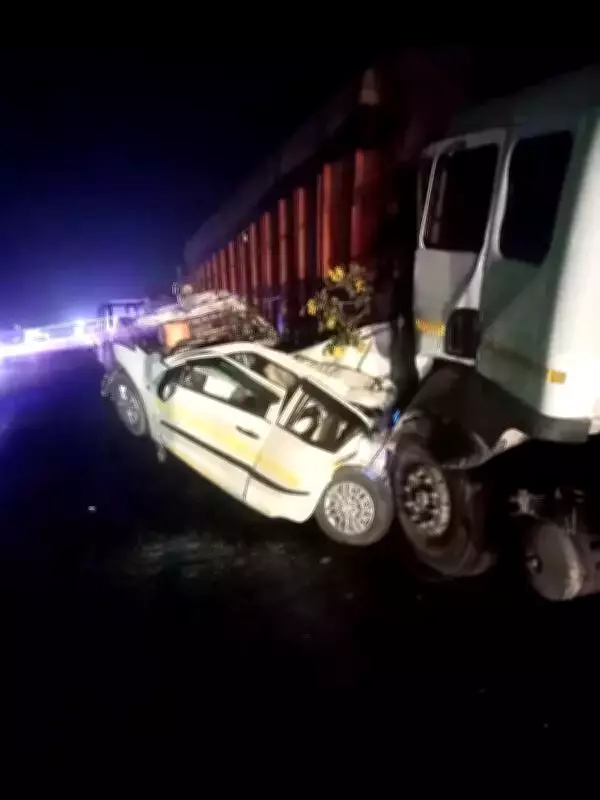
The car first collided with Singh himself, leaving the truck driver with grievous injuries, before crashing into the stationary truck from behind. Within minutes, another heavy vehicle plowed into the Dzire from the rear, crushing the sedan between the two trucks in a devastating sandwich collision.
The impact proved fatal for Michal Majzik and driver Mohammad Nafis, both of whom died before they could be transported to medical facilities. Agnieszka Kacynel sustained critical injuries and is currently undergoing treatment at the All India Institute of Medical Sciences (AIIMS) in Delhi.
Tourists' Tragic Journey Interrupted
Police investigations revealed that the Polish tourists had been picked up from a hotel in Gurgaon and were en route to Agra to visit the iconic Taj Mahal when their journey ended in tragedy. The collision occurred during what should have been a memorable cultural excursion, transforming it instead into a nightmare scenario.
Singh recounted the aftermath: "By the time help arrived, I had already lost consciousness. I was taken to Civil Hospital in Palwal, where medical arrangements were completely inadequate. Only basic bandaging was performed without proper attention or pain relief. My family later arranged for my transfer to this private hospital."
The truck driver suffered multiple fractures in both legs along with injuries to his head, chest, and back from the initial impact with the Dzire.
Official Response and Investigation
Authorities have registered a case under Bharatiya Nyaya Sanhita (BNS) sections 281 and 106, pertaining to rash driving and causing death by negligence. A police official stated: "A detailed investigation has been launched to establish the exact sequence of events and fix responsibility for the accidents. We are examining all aspects of this tragic incident."
Praveen Kumar, sub-divisional officer at Haryana State Industrial and Infrastructure Development Corporation (HSIIDC), which maintains the expressway, acknowledged possible communication gaps while disputing allegations of negligence. He explained that calls to the 1033 helpline are routed through a National Highways Authority of India (NHAI) central hub before being transferred to field teams based on GPS location data.
"My immediate field team received no such calls during the timeframe mentioned by the driver," Kumar stated. "Our team had been deployed nearby to clear a traffic snarl caused by an earlier accident, which was resolved close to 4 AM. Once we were alerted about this fresh accident at 4:42 AM, we responded immediately to rescue the victims. We are currently examining call records and central logs to identify any breakdown in the communication chain."
Broader Implications for Highway Safety
This tragic incident raises serious questions about the effectiveness of emergency response systems on India's expressways. The apparent failure of multiple emergency contact points during a critical window highlights potential systemic issues that could affect countless travelers.
The contrasting accounts between the truck driver's detailed call log and the official claim of no received calls suggest either technological failures in call routing, procedural breakdowns in emergency response protocols, or possibly both. As investigations continue, authorities face mounting pressure to ensure such communication failures do not recur on highways where timely emergency response can mean the difference between life and death.
The tragedy has particularly resonated internationally due to the involvement of foreign tourists, bringing additional scrutiny to India's highway safety infrastructure at a time when the country is actively promoting tourism. The families of the victims, both Indian and Polish, now await answers about why emergency systems failed during those crucial minutes before the fatal collisions.