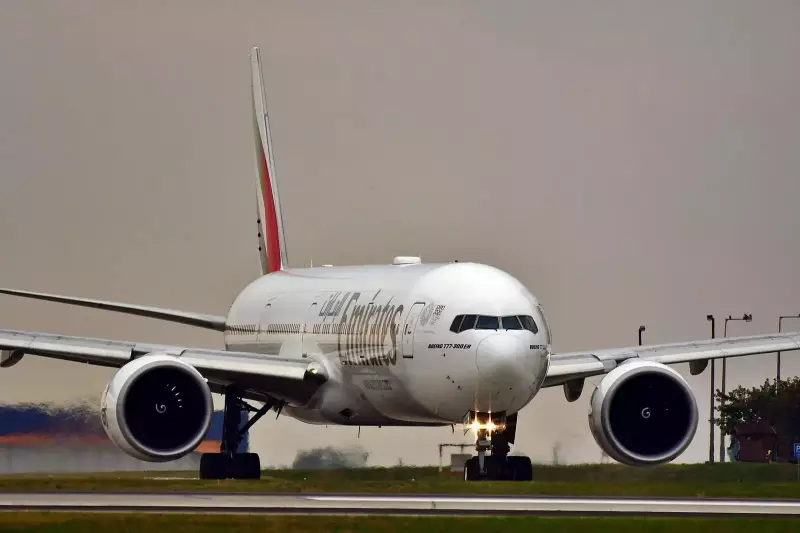
Emirates Flight Forced to Divert to Edinburgh Amid Severe Storm Conditions
What began as a routine eight-hour journey from the sun-drenched runways of Dubai to the historic city of Newcastle transformed into a dramatic aerial battle on Tuesday, January 27, 2026. As Emirates Flight EK35 approached Northern England, it was met by the fierce arrival of Storm Chandra, turning what should have been a straightforward landing into a test of pilot skill and aviation safety protocols.
The Stormy Encounter Over Northern England
The Boeing 777-300ER aircraft encountered a formidable wall of heavy rain, dense mist, and punishing crosswinds reaching up to 60 mph as it neared its destination. These treacherous conditions made the final descent particularly challenging, with pilots fighting to stabilize the massive aircraft against the relentless elements. According to live flight tracking data, the aircraft spent several minutes circling over the Newcastle and Sunderland area before the critical decision was made to divert.
The flight crew issued a Squawk 7700 emergency code, an internationally recognized aviation signal that alerts air traffic control that an aircraft requires priority attention. After two aborted landing attempts at Newcastle Airport, where the flight was originally scheduled to land just after 11:20 am local time, the aircraft continued northward to Edinburgh Airport.

Safe Landing and Emergency Protocols
The diverted flight touched down safely at Edinburgh Airport without any reported injuries to passengers or crew. Emirates confirmed that adverse weather conditions were the primary reason for the diversion, with strong winds, poor visibility, and unsettled weather across northern England making it impossible to safely complete the landing at Newcastle.
"The safety of our passengers and crew is of utmost importance and will not be compromised," an Emirates spokesperson told news agencies, explaining that challenging weather forced the diversion. The airline emphasized that in such situations, pilots commonly perform "go-arounds," where the aircraft ascends again to ensure conditions are suitable before attempting another landing.
Understanding the Squawk 7700 Emergency Code
The Squawk 7700 code is used by pilots to indicate a general emergency. It does not specify a single problem but signals that air traffic control and airport emergency services should give the aircraft priority and be ready to assist if necessary. This code can be triggered for various reasons, including weather challenges, technical checks, or health issues on board.
In this particular case, authorities did not disclose any specific technical or health issues. Aviation experts note that issuing a 7700 alert is a standard safety measure and not necessarily a sign of critical failure. In recent weeks, multiple flights across Europe have declared similar emergency codes and diverted safely, illustrating how modern aviation safety systems function as intended during challenging situations.
Airport Response and Subsequent Journey
Edinburgh Airport confirmed the safe landing of the Emirates flight and noted that local emergency services were placed on standby as a precautionary measure. This is standard procedure whenever a flight declares an emergency, ensuring all necessary resources are immediately available if required.
The aircraft remained on the ground in Edinburgh for approximately two hours while ground teams and Emirates operations staff coordinated the next steps. Once weather conditions were reassessed and arrangements completed, Flight EK35 resumed its journey to Newcastle, departing Edinburgh at 1:53 pm local time and arriving at its original destination around three hours later than scheduled.
Safety Takes Priority Over Schedule
While a three-hour delay can be frustrating for travelers, this incident serves as a powerful reminder of aviation's commitment to safety above all else. Emirates issued an apology for any inconvenience caused to travelers but reiterated that passenger safety remains a "non-negotiable" priority.

Under UK and European passenger protection rules, travelers are often entitled to care and assistance during such disruptions. For the passengers onboard Flight EK35, the stormy detour provided a real-world demonstration of the robust protocols that keep thousands of flights safe every day, even when nature presents unexpected challenges.
The successful handling of this situation highlights the comprehensive training of flight crews, the effectiveness of emergency communication systems, and the coordinated response between airlines and airports during weather-related emergencies.