

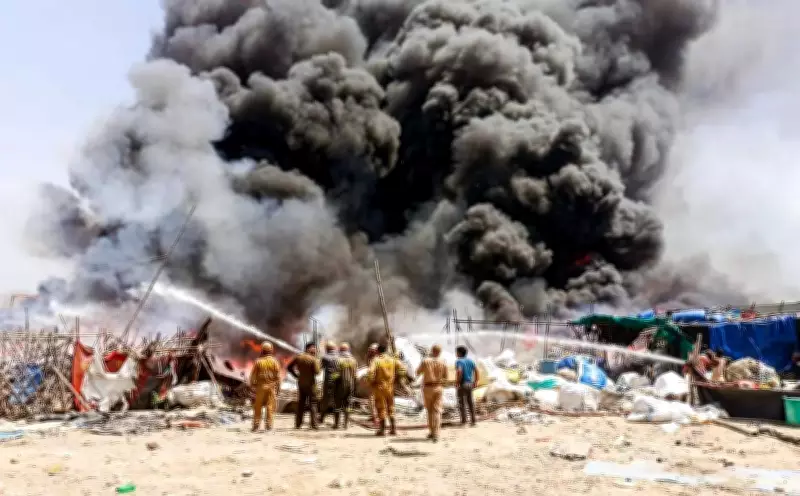
Ghaziabad Slum Cluster Ravaged by Intense Fire, Over 150 Jhuggis Reduced to Ashes
A massive and destructive fire tore through the Kanawani slum cluster in Indirapuram, Ghaziabad, on Thursday afternoon, completely destroying more than 150 jhuggis and triggering a series of terrifying gas cylinder explosions that forced residents into a frantic, stampede-like escape.
Rapid Spread and Chaotic Scenes
The blaze erupted at 12:17 pm, and fueled by strong afternoon winds, it rapidly engulfed the densely packed settlement. Within minutes, the inferno consumed at least 12 scrap warehouses alongside the fragile hutments. Gas cylinders stored inside the jhuggis began exploding in rapid succession, each blast intensifying the panic and chaos among residents.
Thick, dark columns of smoke billowed into the sky, visible from adjacent high-rise towers in Rajnagar Extension and even from parts of Noida, creating a scene of widespread alarm.

Four-Hour Battle to Control the Blaze
Firefighters initially brought the fire under control around 2 pm, but it flared up again, requiring a prolonged effort. The blaze was only fully doused around 4 pm, nearly four hours after it began. Cooling operations continued late into the evening as rescue teams worked at the site.
Chief Fire Officer Rahul Pal detailed the response, stating that four engines arrived quickly after the first call, but this proved insufficient. Ultimately, twenty-two fire engines were mobilized from stations across Ghaziabad, Noida, and Tata Steel. They were deployed simultaneously from four directions in a strategic effort to prevent the flames from reaching the high-rise residential societies bordering the slum area.
Human Cost: Lost Savings and Separated Families
While rescue officials confirmed no lives were lost, the human toll was severe. Most residents reported losing all their savings and furniture in the fire. The disaster left at least 1,000 people homeless, according to official estimates.
Amid the smoke and chaos, several children were separated from their parents, leading to frantic searches. Chandan Paswan, who escaped with his family just in time, recounted the terrifying moment his eight-year-old son got lost in the crowd during their rush to safety. "When we realized my son was missing, we had imagined the worst," he said.
Rescue personnel reported that 10 children were separated from their families as the crowd surged toward the road. Fortunately, all children, including Paswan's son, were found by evening and safely reunited with their families.
Personal Stories of Devastation
Mushtari Khatoon, 35, was waiting for her mother to return for lunch when the fire broke out. Her family had set aside Rs 50,000 for her younger siblings' school admissions. "I heard the explosions. But by the time I understood what was happening, the flames had already made the decision for me," she said. The money was destroyed before she could retrieve it, forcing her to flee empty-handed.
Investigation and Historical Context
Chief Fire Officer Rahul Pal indicated that the blaze is suspected to have started from a domestic stove or a short circuit, with an investigation currently underway. Eyewitness Aakash reported seeing sparks flying from electric wires passing over one of the jhuggis just before the fire took hold.
This was not the first fire to hit Kanawani. In April 2018, a similar blaze gutted 100 jhuggis and displaced around 250 people. A subsequent survey conducted by police on the Ghaziabad Development Authority's direction found nearly 8,000 people, mostly migrant construction laborers from other states, living across 10 large slum clusters in the area. The survey noted that the jhuggis, constructed from tin sheets and polythene, were highly combustible, with fire risks escalating sharply during summer months.
A Ghaziabad Municipal Corporation official stated that the Kanawani cluster housed migrant laborers and that initial investigations pointed to a local mafia renting out hutments on government land. "We plan to conduct a major anti-encroachment drive in the area," the official added.

Administrative Response and Preparedness
The district magistrate, deputy commissioner of police, and chief medical officer were present at the spot along with police and administrative officials. More than 30 ambulances were put on standby, and nearby hospitals were alerted for any emergencies, demonstrating a coordinated response to the disaster.
By nightfall, the settlement of thousands was reduced to a desolate landscape of ash, marking a tragic chapter for the vulnerable community that called it home.





