Goa Government Presents Critical Evidence in Mhadei Water Dispute to Supreme Court
The Goa state government has taken a significant step in the ongoing Mhadei water dispute by submitting three crucial documents to the Supreme Court of India. These documents, which were never presented before the Mhadei Water Disputes Tribunal, reveal substantial discrepancies in water yield assessments for the Mhadei river basin.
Disputed Water Yield Figures
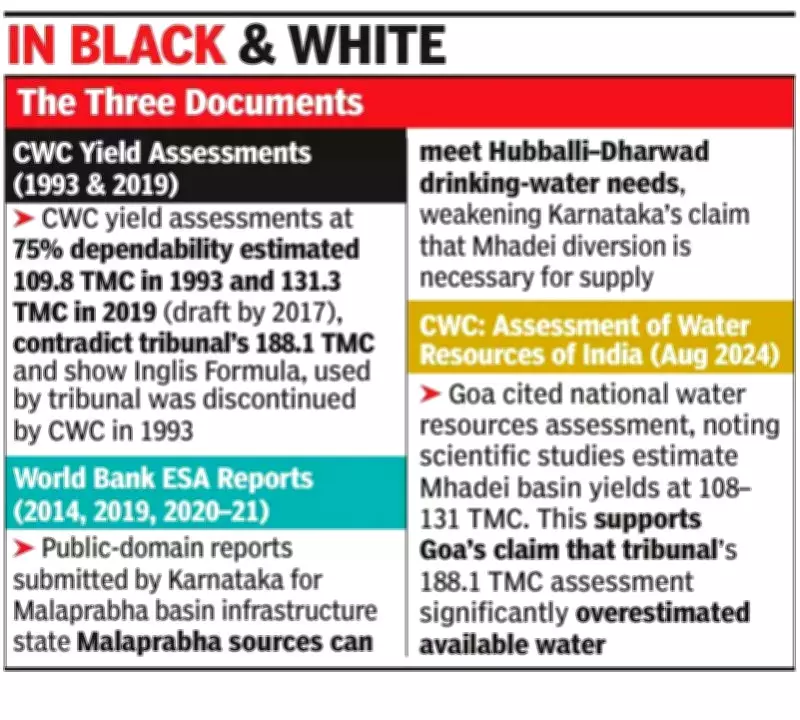
The submitted documents indicate that the actual water yields in the Mhadei basin range between 108 to 131 Thousand Million Cubic feet (TMC). This stands in stark contrast to the tribunal's assessment of 188.1 TMC, representing a significant overestimation by the judicial body.
A senior government official explained the implications: "All these assessments in the reports consistently show yields in the range of 108 to 131 TMC, as compared to the tribunal's assessment of 188.1 TMC. This represents an overestimation by approximately 57 to 80 TMC, or approximately 30% to 43%, by the tribunal."

The Three Critical Documents
The evidence submitted to the Supreme Court includes:
- Central Water Commission Report of 1993: This document assessed the yield of the Mhadei Basin at 109.8 TMC at 75% dependability and has been available since 1993.
- Central Water Commission Report of 2019: This assessment placed the yield at 131.3 TMC at 75% dependability, with its draft available as early as 2017, before the tribunal's award.
- World Bank Documents: These include Environmental and Social Assessment reports from 2014, 2019, and 2020-21 that were submitted by Karnataka to obtain financial support for infrastructure development in the Malaprabha basin.
Methodological Concerns and Historical Context
The tribunal's reliance on outdated methodology has become a central point of contention. The Inglis Formula of 1946, which was used by the tribunal to calculate water yields, was actually abandoned by the Central Water Commission since 1993. This raises serious questions about the scientific basis of the tribunal's calculations.
A senior government officer elaborated on this critical issue: "The tribunal rejected the rainfall and run-off data provided by the three party states as unreliable. In the absence of reliable data, the tribunal relied on the Inglis Formula of 1946 to calculate the run-off and assess the yield at 188.1 TMC at 75% dependability."
Karnataka's Contradictory Position
The World Bank documents reveal particularly damaging information for Karnataka's position in the dispute. These reports contain statements by Karnataka authorities indicating that the water sources available in the Malaprabha basin are sufficient to meet the drinking water needs of the Hubballi-Dharwad twin cities.
This directly contradicts Karnataka's argument that it requires diversion of waters from the Mhadei basin to address water scarcity issues in the region.
Legal Proceedings and Implications
The Goa government filed a civil appeal before the Supreme Court challenging the tribunal's award dated August 14, 2018. Special leave was granted by the Supreme Court in August 2024, allowing the case to proceed to higher judicial scrutiny.
The non-production of these critical documents before the original tribunal proceedings represents what government officials describe as "critical significance" in the case. Had these documents been presented earlier, the tribunal would have had access to reliable scientific data that could have substantially altered its conclusions.
As the Supreme Court now examines this new evidence, the Mhadei water dispute enters a potentially decisive phase that could reshape water allocation in the region for decades to come.