

Gujarat High Court Sets Clear Boundaries for Human Rights Commission
The Gujarat High Court issued a firm directive on Thursday. It told the State Human Rights Commission to stop interfering in private civil disputes. These disputes are currently pending before civil courts. The court also established strict guidelines for the commission's operations. These guidelines must align with the Protection of Human Rights Act.
Court Quashes Proceedings in Land Dispute
The High Court canceled the SHRC's proceedings in a private land dispute. It described the commission's interference as a clear abuse of the legal process. The court called it a serious error. Justice Niral Mehta made a key observation. He stated that rights related to private property should be decided by a competent civil court. Therefore, these rights do not fall under the Protection of Human Rights Act of 1993.
Justice Mehta explained the essential requirement. For any right to qualify as a human right under the Act, it must be guaranteed by the Constitution. The High Court expressed a strong opinion in its order. It said the SHRC's initiation of an inquiry into a private dispute between two individuals exceeded its jurisdiction. This action also amounted to usurping the powers of the civil court.

Guidelines to Prevent Misuse of Power
The High Court emphasized that the SHRC cannot conduct inquiries casually. Such casual approaches defeat the legislature's intent. The commission must ensure a dispute falls within the Human Rights Act's scope. The court warned that entertaining such complaints, issuing summons, and taking cognisance can have serious consequences.
To prevent future abuses, the High Court issued several directions. These directions aim to ensure the Act's powers are not misused. The court outlined specific limits for the commission's functioning.
Key Directives from the High Court
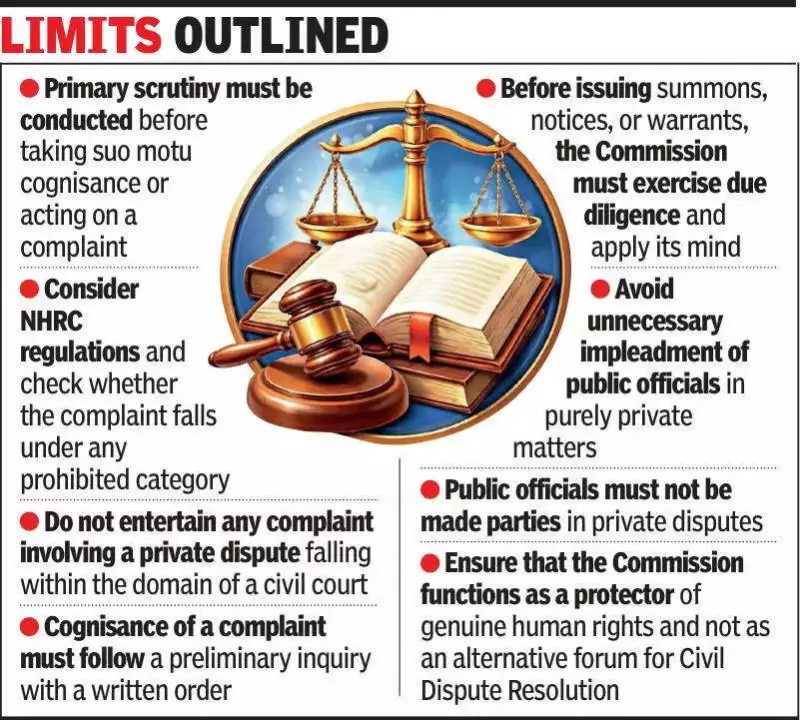
The High Court provided a detailed list of guidelines for the SHRC. These include:
- Conduct primary scrutiny before taking suo motu cognisance or acting on a complaint.
- Consider NHRC regulations and check if the complaint falls under any prohibited category.
- Do not entertain complaints involving private disputes that belong to civil courts.
- Ensure cognisance of a complaint follows a preliminary inquiry with a written order.
- Exercise due diligence and apply careful thought before issuing summons, notices, or warrants.
- Avoid unnecessary impleadment of public officials in purely private matters.
- Public officials must not be made parties in private disputes.
- Periodically train members and staff on statutory jurisdiction limits.
- Ensure the Commission functions as a protector of genuine human rights, not as an alternative forum for civil dispute resolution.
The Gujarat High Court's ruling reinforces the separation of legal domains. It clarifies that human rights commissions should focus on constitutional rights, not private civil matters. This decision aims to streamline legal processes and prevent jurisdictional overlaps.






