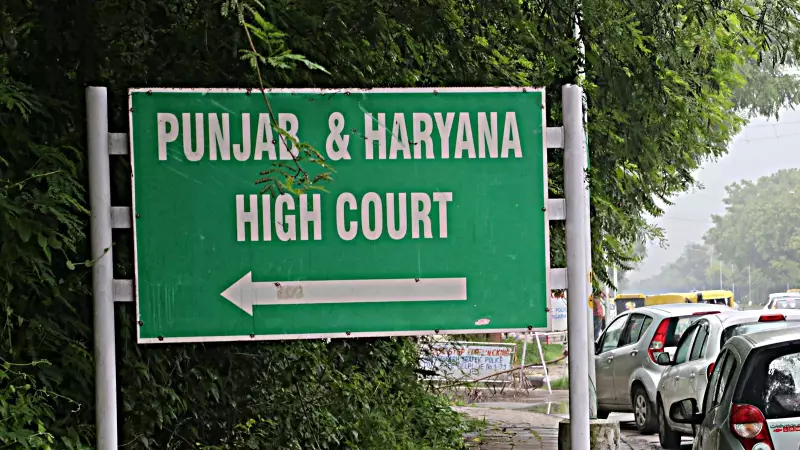
Punjab and Haryana High Court Prohibits Use of 'Subordinate' and 'Lower' for District Courts
The Punjab and Haryana High Court has issued a significant directive to all courts in Punjab, Haryana, and the Union Territory of Chandigarh. This circular mandates a change in official language used for referring to courts below the High Court level.
New Terminology for Official Records
According to the circular from the Registration General, courts must now use specific terms in all official correspondence and judicial proceedings. The approved terms are "District Courts", "District Judiciary", or "Trial Courts". The High Court explicitly bans the use of older terms like "Subordinate Judge", "Subordinate Courts", or "Lower Courts".
The directive states these banned terms should not appear in any official documents unless absolutely unavoidable. This move aims to promote respect and proper recognition for the district judiciary's role.

Supreme Court's Influence on Judicial Language
This decision follows recent observations and orders from the Supreme Court of India regarding judicial nomenclature. In February 2024, a Supreme Court bench comprising Justices Abhay S Oka and Ujjal Bhuyan instructed its own registry to stop referring to trial courts as "lower courts". The bench emphasized the need for appropriate language that reflects the dignity of these courts.
Earlier, in May 2023, the Supreme Court made a similar statement in the All India Judges Association v. Union of India case. The Court declared it would no longer use the term "subordinate judiciary" for district courts. It highlighted that the word "subordinate" is a misnomer because district courts play an independent and crucial role under the Constitution.
Broader Trend Across Indian High Courts
The Punjab and Haryana High Court is not alone in this initiative. Other high courts in India have taken similar steps in recent years to update judicial terminology. For instance, the Karnataka High Court issued a directive in 2020 prohibiting the use of "lower court" or "subordinate court" in appellate references.
This trend reflects a growing awareness within the judiciary about the importance of language in shaping perceptions. While Article 235 of the Constitution gives high courts administrative control over subordinate courts, the Supreme Court has clarified this does not imply any inferiority. The control is purely administrative, not hierarchical in terms of judicial function.
Implications for Judicial Proceedings
The new directive from the Punjab and Haryana High Court will affect all official documents and communications in the region. Lawyers, judges, and court staff must now adopt the updated terminology. This change is expected to foster a more respectful and accurate portrayal of the district judiciary's work.
By eliminating terms that suggest inferiority, the High Court aims to strengthen the public's trust in the judicial system. It underscores the vital role district courts play in delivering justice at the grassroots level.