

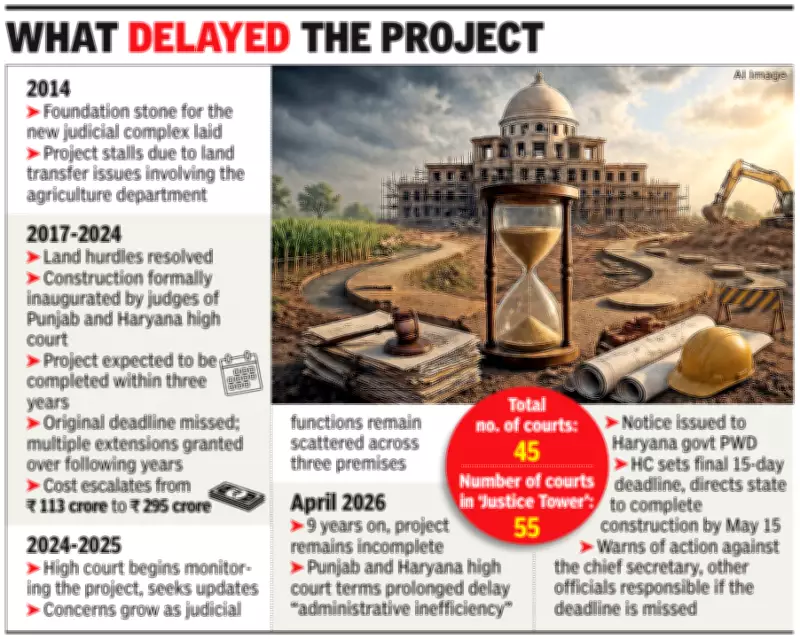
The Punjab and Haryana High Court has taken a stern stance on the prolonged delay in constructing the Tower of Justice in Gurgaon, a judicial complex planned over seven acres. The project, which began in 2017 with a three-year completion target, remains unfinished nine years later. The High Court described the repeated delays as a sign of administrative inefficiency and issued a notice to the state government.
Final Deadline Set for May 15
On Wednesday, the court set May 15 as the final deadline for completion. It warned that if the project is not finished by then, it may initiate action against the chief secretary and other responsible officials. The court expressed frustration over previous extensions and the lack of urgency shown by authorities.
The High Court stated, The delay in completing such an important judicial infrastructure project is a matter of grave concern. Despite several opportunities and longer timelines given earlier, the work remains unfinished. It added that responsibility would be fixed and action could be taken if the deadline is missed again.

Project Scope and Current Status
The Tower of Justice will consist of two blocks, one with eight floors and the other with seven, accommodating 55 district and sessions courts. Currently, the city has 45 courts handling around 65,000 pending cases. The cost of the project has escalated from an initial estimate of Rs 113 crore to Rs 295 crore.
The foundation stone was laid in 2014, but the project was delayed mainly due to issues related to the transfer of land held by the agriculture department. After the land hurdle was cleared, construction was inaugurated by several High Court judges in January 2017, with an expected completion by 2020.
Facilities Planned for the Complex
Each floor will have a waiting area and seating for assistant district attorneys. The ground floor will include a single-window care centre for legal services and a centralised complaint filing system. The first floor will house a library and a bar room with seating for 1,500 people. For the first time, women advocates will have a separate bar room. The premises will also feature multi-level parking.
To improve security and prevent untoward incidents, separate entry and lift access have been planned for accused persons appearing in court. The complex will have 20 mediation centres, compared with only six in other districts. A separate block will house facilities such as banks and post offices.
Current Challenges
Due to lack of space, court operations are currently spread across three premises. Lawyers struggle to find seating, and vehicles parked around the court complex often disrupt traffic movement. Rajiv Kaushik, a member of the district bar association, said, At present, four judges sit at the mini secretariat, four at Vikas Sadan, and other judges in the district court complex, leading to a lot of roaming around for even minor matters.
When contacted, officials from the Public Works Department, the executing agency, declined to comment, citing that the matter is sub judice. An official said, The matter is before the court. We are not in a position to say anything at this point.






