

High Court Condemns Government Agencies for Making Housing Unaffordable in Tricity
The Punjab and Haryana High Court has issued a stern rebuke to government development agencies operating in the Tricity region of Chandigarh, Panchkula, and Mohali. The court has raised serious concerns over the soaring prices of residential plots and flats being auctioned by these agencies, stating that such rates have effectively placed home ownership beyond the reach of the middle class and salaried professionals.
Court Observes Government Profiteering at the Expense of Common Citizens
A division bench headed by Justice Anupinder Singh Grewal observed that it appears the states have started indulging in profiteering, leaving the common man in a lurch. The bench noted that prices of residential plots and flats which are being auctioned are exorbitant and unjustifiable. The court pointed out that government instrumentalities are cash rich and have plenty of reserves in their kitty, but instead of utilizing these resources to provide affordable housing to everyday citizens and the middle class, they are putting residential plots and flats to auction where minimum bid amounts run into crores.
The bench specifically mentioned agencies such as HSVP, GMADA, and Chandigarh Housing Board, noting that although these government bodies initially had various schemes for allotment of plots including by way of draw of lots, they have now opted to auction residential plots, deviating from the real object of their statute.

Constitutional Right to Affordable Housing
Justice Grewal held that Article 21 of the Constitution, which guarantees the right to life and liberty, includes the right to shelter and affordable housing. The court emphasized that it is the bounden duty of the states to provide affordable housing to all sections of society. The bench observed that the prices at which residential plots or flats are being auctioned in the Tricity are completely out of reach for professionals, the salaried class, and other not-so-affluent sections of society, including the middle class.
The court also noted concerning practices in the auction system, including that earlier restrictions limiting allotment to one plot per family appear to have been done away with. The bench reported coming across several instances where a single person has applied and been allotted multiple residential plots or flats through these auctions.
Court Directs States to Propose Solutions
In response to these findings, the High Court has directed the states of Haryana, Punjab, and the Union Territory of Chandigarh to put forth a comprehensive proposal to address the issue of affordable housing. The court has suggested that authorities consider taking other measures, including the draw of lots system, to ensure housing accessibility for all sections of society, particularly the salaried and middle classes.
The bench has appointed Shreenath A. Khemka, an advocate who was present in court, as amicus curiae to assist in the matter. The case has been adjourned for further hearing on March 24, giving the states time to develop their proposals for addressing the affordable housing crisis in the region.
Key Concerns Highlighted by the Court
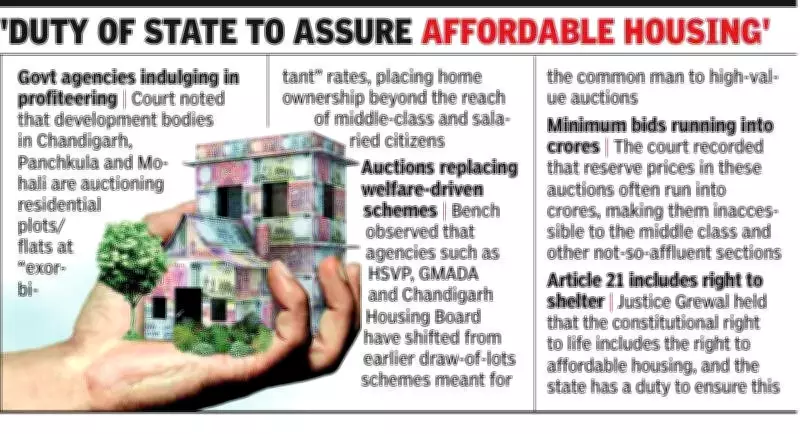
- Government development bodies in Chandigarh, Panchkula, and Mohali are auctioning residential plots and flats at exorbitant rates
- These auction practices have placed home ownership beyond the reach of middle-class and salaried citizens
- Agencies have shifted from welfare-driven draw-of-lots schemes to high-value auctions
- Reserve prices in these auctions often run into crores, making them inaccessible to ordinary citizens
- The constitutional right to life includes the right to affordable housing, creating a duty for the state to ensure this
This judicial intervention comes at a critical time when housing affordability has become a major concern across urban centers in India. The High Court's observations highlight a significant shift in government housing policies from welfare-oriented approaches to revenue-generating practices that exclude the very citizens these agencies were established to serve.






