

The Punjab and Haryana High Court has taken suo motu cognisance of a Times of India news report that highlighted the deteriorating condition of the Le Corbusier Centre in Sector 19, Chandigarh. The court has directed the Chandigarh administration to submit a detailed compliance report on the measures being taken for its renovation and repair.
Court's Intervention
A division bench comprising Justice Sheel Nagu and Justice Sanjiv Berry, on Friday, referred to the TOI report titled "Chandigarh's Birthplace Battles For Life," published on May 7. The report detailed the neglect and poor maintenance of the heritage building, which is regarded as the birthplace of Chandigarh's planning and design. The court questioned the UT administration on the upkeep of this iconic structure.
Appearing for the Chandigarh administration, the counsel assured the court that efforts are underway to renovate and repair the centre. It was further assured that a status report would be placed before the court.

Observations and Directions
Recording the submissions, the bench observed: "This Court has taken suo motu cognisance of the matter on the strength of a newspaper item published in the Times of India dated May 7, 2026, in regard to the dilapidated condition of the Le Corbusier Centre, Sector 19, Chandigarh." The court noted the administration's assurance and adjourned the matter for filing of a compliance report on proposed restoration and preservation measures.
Significance of the Le Corbusier Centre
The Le Corbusier Centre, a museum dedicated to the city's founding and the legacy of Swiss-French architect Le Corbusier, is one of Chandigarh's most significant heritage landmarks. It is so well respected that for architects, heritage experts and international tourists, it is a pilgrimage of sorts.
Neglect Highlighted in TOI Report
- In the main hall — the original workspace where Le Corbusier and his team, including Pierre Jeanneret, Jane Drew and Maxwell Fry, conceptualised and designed Chandigarh nearly seven decades ago — several roof tiles are missing or broken.
- Historical photographs and letters lie covered in dust, while descriptive plaques have worn out.
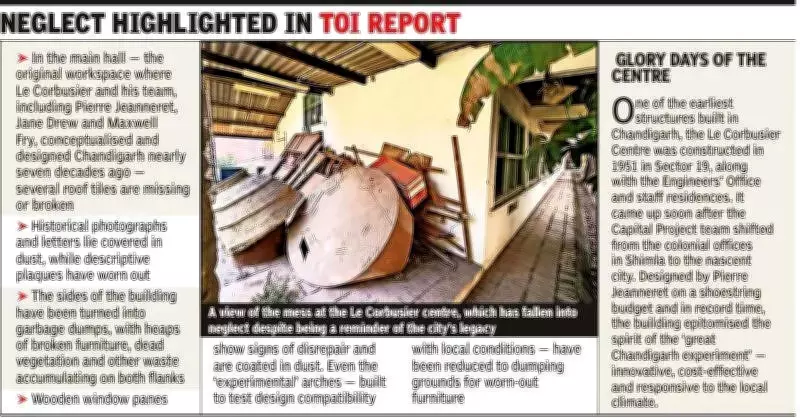
- The sides of the building have been turned into garbage dumps, with heaps of broken furniture, dead vegetation and other waste accumulating on both flanks.
- Wooden window panes show signs of disrepair and are coated in dust. Even the ‘experimental' arches — built to test design compatibility with local conditions — have been reduced to dumping grounds for worn-out furniture.
Glory Days of the Centre
One of the earliest structures built in Chandigarh, the Le Corbusier Centre was constructed in 1951 in Sector 19, along with the Engineers' Office and staff residences. It came up soon after the Capital Project team shifted from the colonial offices in Shimla to the nascent city. Designed by Pierre Jeanneret on a shoestring budget and in record time, the building epitomised the spirit of the ‘great Chandigarh experiment' — innovative, cost-effective and responsive to the local climate.






