

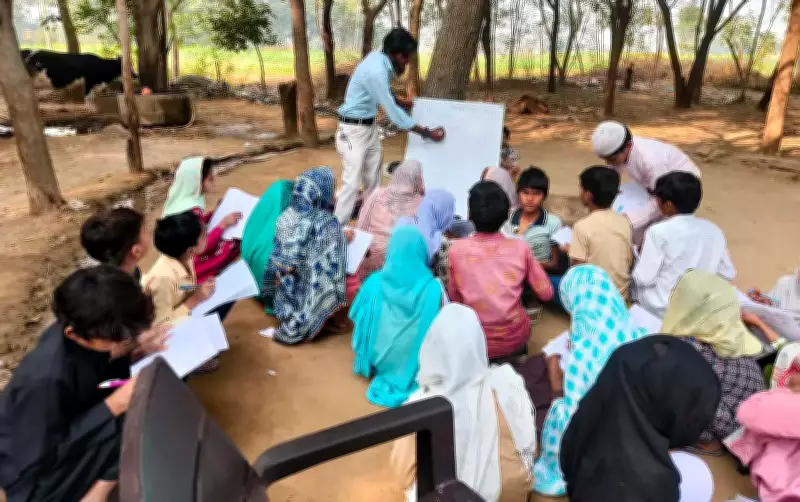
The Haryana Human Rights Commission (HHRC) on Thursday took cognisance of a Times of India (TOI) report published earlier this week, which highlighted that government primary schools in the Nuh district are operating from makeshift premises, including a cowshed and a chaupal building. The commission has directed the Haryana chief secretary, the school education department, the Nuh deputy commissioner, and the district education officer to submit detailed reports on the condition of schools, lack of infrastructure, and shortage of teachers in the district.
In its order dated May 7, the HHRC observed that the situation represents a basic violation of children's fundamental and human rights, including the right to education, dignity, and health. The TOI report published on May 6 provided a ground-level account of how government schools, which are listed as fully functional on paper, are actually operating in substandard conditions across Nuh.
Comprehensive Report Sought from Chief Secretary
The HHRC stated that the chief secretary must submit a comprehensive report covering policy decisions, fund allocation, interdepartmental coordination, and a clear time-bound framework to ensure proper school infrastructure and compliance with statutory norms. The commission emphasised the need for a systematic approach to address the deficiencies.

Departmental Report on Infrastructure and Land Issues
The principal secretary of the school education department has been asked to file a departmental report detailing the infrastructure status of schools in Nuh, timelines for constructing permanent and accessible buildings, and an inquiry into the allotment of school land located 3.5 kilometres from the habitation. The report must also include corrective measures, such as providing safe transport or shifting the school within one kilometre in line with the Right to Education (RTE) norms. Additionally, it should address teacher availability and rational deployment, appointments from local or nearby areas, and steps to improve student enrolment and retention.
Ground-Level Inspection Ordered
The Nuh deputy commissioner and district education officer have been directed to submit a factual ground report based on physical inspections. This report must cover the actual functioning of schools, the availability and suitability of land including panchayat land for school construction, measures taken to ensure safe and hygienic learning environments, and immediate remedial steps taken in coordination with local authorities.
The HHRC observed, "Forcing children to study in environments exposed to animal waste, extreme weather, and unsafe structures amounts to institutional neglect and denial of equal opportunities, particularly affecting children belonging to marginalised and rural communities. Allotting school land far from the habitation defeats the very purpose of accessibility."
Violation of National and International Norms
The commission noted that the conditions in these schools are inconsistent with India's obligations under the United Nations Convention on the Rights of the Child. It stated, "The facts, as reported, prima facie disclose a clear violation of provisions of the Right of Children to Free and Compulsory Education Act, 2009. This Act places a statutory obligation upon the state and local authorities to ensure the availability of proper school infrastructure, safe buildings, teaching staff, and a child-friendly learning environment." The Act lays down minimum standards for classrooms, sanitation, drinking water, and boundary walls. Running schools from cattle sheds, open fields, or dilapidated structures directly violates these mandatory norms. The panel also highlighted that the Act requires a primary school to be located within one kilometre of the habitation.
Teacher Shortage and Deployment Issues
The commission further observed a severe shortage of teaching staff. It noted that appointments made through Haryana Kaushal Rozgar Nigam had resulted in contractual teachers being posted from distant districts such as Bahadurgarh, Rewari, and Mahendergarh. "Because of long travel distances and a lack of basic facilities, several teachers reportedly resigned, worsening the already strained educational environment," the HHRC said.

The commission added, "The report further indicates that although panchayat land has been identified for construction of a school building, the same is located approximately 3.5 kilometres away in Rawli village. Such distance is impractical for young children, particularly those in primary classes, who cannot be expected to travel that far daily, thereby rendering the identified land ineffective for the intended purpose."





