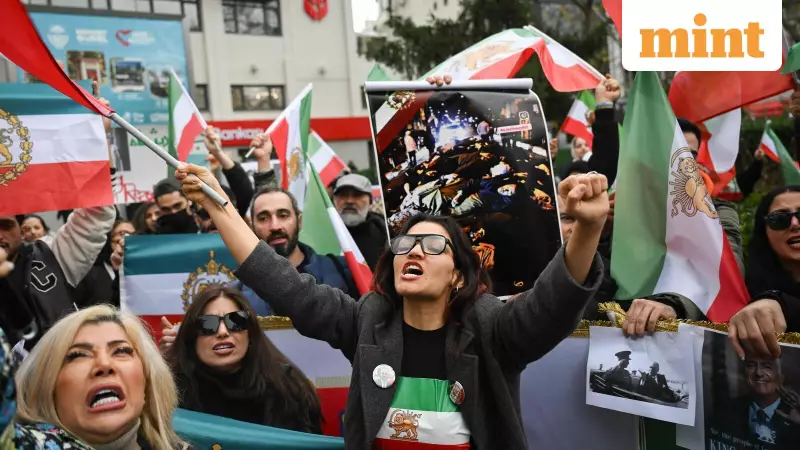
West Asia Breathes Easier as Iran Protests Subside
The world has narrowly avoided another major conflict, at least for now. Deadly protests in Iran have largely subsided following a brutal government crackdown that reportedly killed thousands of people. Monitors confirmed this development on January 16, noting the severe impact of an ongoing internet blackout across the country.
This easing of tensions comes after days of high anxiety in the region. Many observers feared direct American intervention might escalate the situation into a full-scale war.
Trump's Threat and Regional Diplomacy
Alarm bells rang loudly when US President Donald Trump hinted at military action against Iran. On January 13, he posted an all-caps message on his Truth Social platform that read "HELP IS ON THE WAY." The message urged Iranian protesters to continue their demonstrations and even used his signature slogan adapted for Iran: "MIGA" or "Make Iran Great Again."

However, key Arab states quickly moved to prevent escalation. Saudi Arabia, Oman, and Qatar reportedly persuaded the Trump administration to hold back from any attack. Arab leaders expressed serious concerns about regional blowback and the potential for complete chaos.
Their logic was straightforward. A US strike could destabilize the entire region while simultaneously strengthening Israel's position as the dominant power. This outcome would leave Arab states permanently in a secondary position, something they strongly wished to avoid.
For now, Trump appears to be holding back, though some precautionary military movements have occurred. US personnel have reportedly been relocated from major bases in Qatar, while diplomatic staff in Saudi Arabia and Kuwait received security warnings.
The Nature of Iran's Protests
The recent protests in Iran began over economic issues, particularly spiraling inflation that has devastated ordinary citizens. The demonstrations quickly spread across all thirty-one provinces of the country, becoming the largest and most widespread since the 2022 protests following Mahsa Amini's death.
Estimates suggest between 2,500 and 3,000 people may have died in clashes with security forces. Authorities detained thousands more. The internet blackout has made accurate assessment difficult, with most information coming through Western media channels.
This protest wave showed some distinct characteristics. The trading class, known as bazaaris and traditionally considered pillars of the regime, appeared to form the backbone of demonstrations. This represented a significant shift in the protest movement's composition.
The Iranian regime also appears weaker than in previous years. Israel's military actions against Hamas and Hezbollah, combined with the killing of several Iranian Revolutionary Guard commanders, have diminished Tehran's regional influence. The US bombing of key nuclear sites in 2025 further weakened the government's position.
Additionally, Iran lost a key ally when Bashar al-Assad's government collapsed in Syria during 2024. These combined developments have seriously damaged the regime's domestic image and authority.
India's Strategic Nightmare
While the immediate crisis may have subsided, New Delhi faces serious concerns. Beyond the immediate task of ensuring the safety of nearly 10,000 Indian citizens in Iran, India risks losing a crucial regional partner with significant geopolitical consequences.
India has made substantial investments in Iran's Chabahar port, a strategic project designed to bypass Pakistan and access landlocked Afghanistan and Central Asia. The port also forms a critical link in the International North-South Transport Corridor, providing India with access to Russian markets.
Historically, Iran has often aligned with Indian interests against Pakistan. The countries cooperated during the Northern Alliance period in Afghanistan after the Taliban seized Kabul in 1996. More recently in 2024, tensions between Iran and Pakistan briefly flared when Tehran struck what it called "Iranian terrorists on Pakistani soil."

President Trump has repeatedly tried to weaken the India-Iran partnership. In February 2025, he threatened sanctions against countries providing economic relief to Iran, explicitly mentioning those involved with the Chabahar port project. India secured a waiver until April 2026, but this protection now appears fragile.
In 2018, during Trump's first term, India was forced to completely stop oil purchases from Iran after the US withdrew from the 2015 nuclear deal. Iran subsequently turned increasingly toward China for partnership and support.
Trump has again threatened high tariffs on countries trading with Iran, with some estimates suggesting levies could exceed 50%. This creates serious concerns for Indian policymakers and businesses engaged with Iran.
Broader Regional Implications
Prolonged instability in Iran risks spilling over into the wider West Asian region, which remains vitally important to India for several reasons:
- Energy Security: The region supplies crucial oil and gas to India
- Remittances: Between nine and ten million Indians live and work in West Asia
- Investments: Indian companies have significant business interests throughout the region
With India already facing US pressure to reduce purchases of Russian oil, any disruption in West Asia would drive up fuel prices domestically. This would feed inflation and potentially slow economic growth, creating a perfect storm of challenges for New Delhi.
The Nobel Peace Prize Controversy
In a related development, Donald Trump appears to have achieved his long-cherished dream of Nobel recognition, though through unconventional means. Venezuelan opposition leader Maria Corina Machado, the official recipient of the 2025 Nobel Peace Prize, presented her medal to Trump on January 15.
She described the gesture as "a recognition for his unique commitment to our freedom." This occurred just one week after US forces captured Venezuelan President Nicolás Maduro. Photographs showed Trump smiling broadly while holding the medal, though he made no formal statement.
The Nobel Committee quickly reiterated that Peace Prizes cannot be transferred, shared, or revoked under foundation statutes. They emphasized that award decisions are final and permanent. However, given Trump's well-documented disregard for conventions, the 2025 Nobel Peace Prize effectively belongs to him in practical terms.
New US Ambassador to India
India finally has a new American ambassador after nearly a year without one. Sergio Gor presented his credentials to President Droupadi Murmu on January 14, taking over the post at just thirty-eight years old. This makes him the youngest US ambassador to India in history.
His greatest asset appears to be his close relationship with President Trump. In a speech delivered before his formal ceremony, Gor emphasized that "real friends can disagree but always resolve their differences in the end."
Trade negotiations sit high on his agenda, with both sides showing possible urgency in reaching a deal. However, Gor also underlined the Trump administration's emphasis on reciprocity in international relations.
Significantly, he invited India to join Pax Silica, a US-led initiative to secure critical minerals supply chains. This represents a clear example of "friend-shoring" under the Trump doctrine, where allies work together to reduce dependence on geopolitical rivals.
Overall, Gor's appointment represents a positive development in US-India relations. Given his proximity to Trump, he could prove instrumental in resolving some persistent issues in the bilateral relationship.
The immediate war threat may have passed, but the underlying tensions remain. For India, the situation presents multiple challenges that require careful navigation in the coming months. Regional stability, energy security, and strategic partnerships all hang in the balance as events continue to unfold in West Asia.