

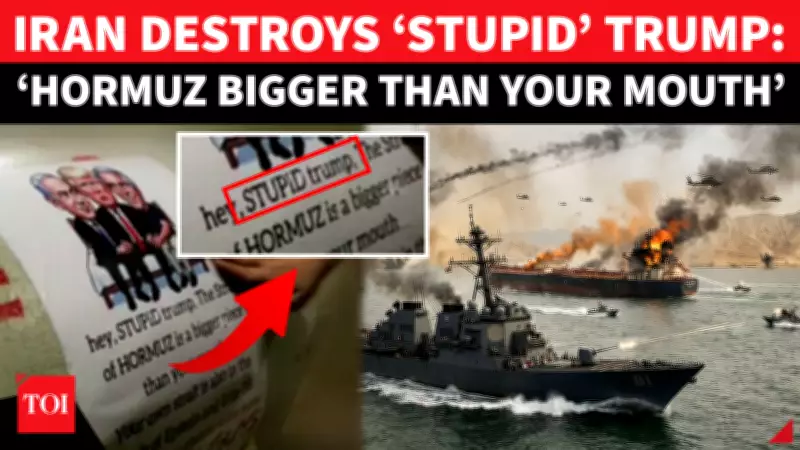
Iran's Revolutionary Guard Launches Missiles with Direct Message to Trump
In a dramatic escalation of tensions, Iran's Islamic Revolutionary Guard Corps has launched a coordinated missile and drone offensive targeting US-linked infrastructure across the Gulf region. The operation, conducted under Wave 90 of Operation True Promise 4, represents a significant shift in military strategy that blends traditional force with unprecedented political messaging.
Personalized Military Messaging
The most striking aspect of this latest offensive is the personalized nature of the communication. In video footage released prior to the strikes, missiles were clearly visible bearing the words "Hey, Stupid Trump" - an unusually direct and confrontational message aimed directly at the US President. This marks a clear departure from conventional military operations where rhetoric typically remains confined to official statements and diplomatic channels.
This development represents a new phase in the ongoing conflict, where political messaging has become embedded directly into the imagery of military action. The Iranian forces have effectively weaponized their communication strategy, using the missiles themselves as platforms for political expression rather than relying solely on traditional press releases or official statements.

Coordinated Offensive Targets Gulf Infrastructure
The military operation itself was substantial in scope and execution. According to Iranian military sources, the coordinated strikes targeted what they described as US-linked industrial and military infrastructure across multiple locations in the Gulf region. The precision and coordination demonstrated in these attacks suggest significant planning and preparation by Iranian forces.
The timing of these strikes is particularly noteworthy, coming at a moment of heightened tensions between Iran and the United States. The personalized nature of the messaging indicates that Iranian leadership is deliberately choosing to escalate the rhetorical dimension of the conflict alongside the military dimension, creating a multi-layered challenge for US policymakers.
Strategic Implications and Regional Impact
This development has several important implications for regional security:
- New communication tactics in military operations that blend force with direct political messaging
- Increased personalization of international conflicts targeting specific political leaders
- Potential escalation of tensions in an already volatile Gulf region
- Changed dynamics in how nations communicate during military confrontations
The Iranian strategy appears designed to achieve multiple objectives simultaneously - demonstrating military capability while delivering a political message directly to the highest levels of US leadership. This approach represents a significant evolution in how nations conduct and communicate about military operations in the modern era.
Broader Context of Regional Tensions
This latest escalation occurs against a backdrop of ongoing tensions between Iran and the United States, with multiple flashpoints across the Middle East. The Gulf region has been particularly volatile, with previous incidents involving shipping lanes, energy infrastructure, and military assets creating a complex security environment.
The personalized nature of the messaging suggests that Iranian leadership is seeking to communicate directly with US political leadership rather than through traditional diplomatic channels. This approach may reflect a calculation that conventional diplomatic communication has become ineffective or that more dramatic measures are necessary to capture attention and influence policy decisions.
As regional tensions continue to evolve, this development represents a significant milestone in how nations communicate during military confrontations. The blending of military action with direct political messaging creates new challenges for international diplomacy and conflict resolution, potentially setting precedents for how future conflicts might be conducted and communicated.






