

Jaipur Police Crack Down on Massive Export Incentive Fraud, Arrest Five Accused
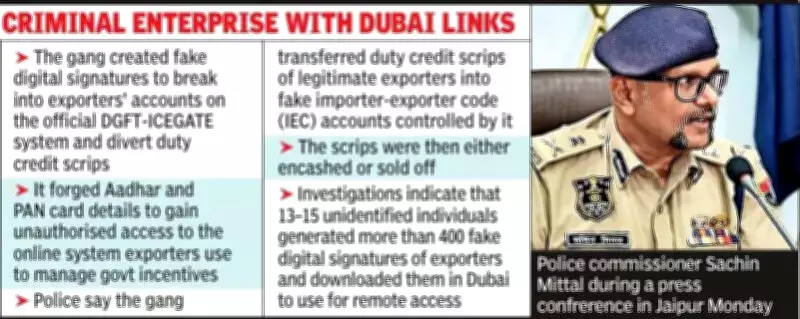
In a significant breakthrough, Jaipur City Police on Monday apprehended five individuals for their alleged involvement in a sophisticated racket that siphoned export incentive scrips by illegally accessing government portals. Authorities estimate this elaborate scheme may have inflicted losses of nearly Rs 400 crore on the national exchequer, highlighting a major vulnerability in digital trade systems.
Accused Identified as Residents of Jodhpur
Jaipur Police Commissioner Sachin Mittal officially named the arrested suspects as Sultan Khan, Nand Kishor, Nirmal Soni, Ashok Kumar Bhandari, and Pramod Khatri. All five are residents of Jodhpur, indicating the operation's geographical spread beyond Jaipur. The arrests follow intensive investigations into fraudulent activities targeting export-linked financial incentives.
Modus Operandi: Fake Digital Signatures and Unauthorized Portal Access
Special Commissioner Om Prakash detailed the group's sophisticated methodology. The accused allegedly created counterfeit digital signatures using forged identity documents, including Aadhaar and PAN cards. These fraudulent Digital Signature Certificates (DSCs) were then employed to gain unauthorized entry into exporters' accounts on the critical Director General of Foreign Trade-Indian Customs Electronic Gateway (DGFT-ICEGATE) system.

The DGFT-ICEGATE platform is a vital government interface that exporters utilize to manage official incentives tied to import and export activities. By breaching this system, the perpetrators could manipulate sensitive financial instruments directly.
Diverting Duty Credit Scrips Through Fake Accounts
Once inside the system, police explained, the accused extracted details of legitimate exporters. They then illicitly transferred duty credit scrips—issued under key export promotion schemes like the Remission of Duties and Taxes on Exported Products (RODTEP) and the Rebate of State and Central Taxes and Levies (ROSCTL)—into fake importer-exporter code (IEC) accounts under their control.
These scrips, essentially financial credits that can be used to offset customs duties or sold for cash, were subsequently encashed or sold off, generating illegal profits. The scale of the transfers points to a highly organized operation targeting substantial government subsidies.
Complex Money Laundering Through Mule Accounts
Investigators uncovered that the illicit proceeds were funneled through a network of 'mule accounts.' These are legitimate bank accounts exploited by criminals to receive, transfer, and launder illegally obtained funds, effectively obscuring the money trail. This layering technique made tracking the financial flows exceptionally challenging, underscoring the racket's advanced operational tactics.
The arrest of these five individuals marks a crucial step in dismantling this fraudulent network, but authorities continue to probe deeper into the full extent of the scam and potential accomplices. The case raises urgent questions about cybersecurity safeguards within government trade portals and the need for enhanced verification processes to prevent similar large-scale frauds in the future.






