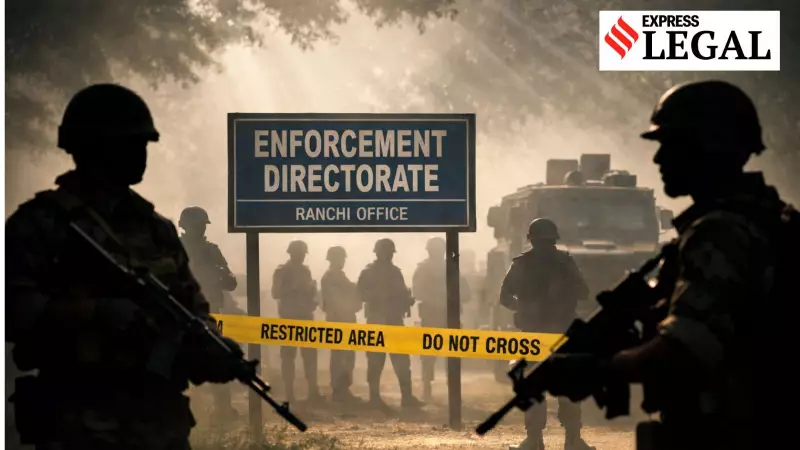
Jharkhand High Court Intervenes in ED Case, Deploys Forces to Guard Ranchi Office
The Jharkhand High Court has taken decisive action in a high-profile case involving the Enforcement Directorate. On Friday, the court stayed an investigation by Jharkhand Police against ED officials. It also ordered the central government to deploy paramilitary forces to protect the ED's office in Ranchi.
Court Says It Cannot Be a Mute Spectator
Justice Sanjay Kumar Dwivedi presided over the hearing. He considered a petition filed by ED officials. The officials sought either the quashing of an FIR or the transfer of the investigation to the Central Bureau of Investigation.
In his order dated January 16, Justice Dwivedi made a strong statement. He noted that High Courts typically hesitate to grant interim protection at the early stages of an FIR. However, he emphasized that in this particular situation, the court could not remain a passive observer.

The court explicitly stated, "The High Courts are very slow in passing interim protection at the initial stage of the FIR, however, in the facts like present one brought before the High Court, the High Court cannot be a mute spectator."
Key Directives from the High Court
The Jharkhand High Court issued several important directions:
- The court imposed an immediate stay on all further proceedings and investigation by the police until the next hearing.
- It directed the Union Home Secretary to deploy either the Central Industrial Security Force, the Border Security Force, or another suitable paramilitary force to secure the Enforcement Directorate office in Ranchi.
- The Senior Superintendent of Police in Ranchi received instructions to oversee the security arrangements for the ED office.
- The court made it clear that if any untoward incident occurs at the ED office, the SSP of Ranchi will be held personally liable.
- Authorities must preserve all CCTV footage from the premises of the Enforcement Directorate.
Legal Protection Under PMLA
The court's order referenced Section 67 of the Prevention of Money-Laundering Act. This section provides significant legal protection to government officials acting in good faith under the Act.
Section 67 specifically prohibits civil courts from modifying or setting aside any orders or proceedings issued under PMLA. More importantly, it grants legal immunity to officials for actions taken in good faith while performing their duties under the Act.
Background of the Case
The controversy began on January 13 when the airport police station in Ranchi registered a case. The FIR named two ED officials: an assistant director and an assistant enforcement officer from the Ranchi Zonal Office.
Police charged the officials under multiple sections of the Bharatiya Nyaya Sanhita, 2023. These included provisions related to abetment, wrongful confinement, criminal intimidation, and causing disappearance of evidence.
According to the ED officials' petition, the informant in the case is Santosh Kumar. He stands as the principal accused in a separate investigation involving alleged misappropriation of approximately Rs 23 crore from Jharkhand's drinking water and sanitation department.
The petitioners claimed that although Kumar was not summoned, he voluntarily appeared at the ED office on January 12. During questioning, he allegedly struck a glass water jug against his own head, resulting in a minor injury. Following this incident, police registered the case against the ED officers.
Arguments Presented in Court
Advocates representing the ED officials presented several key arguments before the High Court. They emphasized that the Ranchi office handles numerous high-profile and sensitive investigations. These cases involve influential political figures and senior bureaucrats.
The legal counsel argued that the FIR and subsequent police actions represented a pre-planned tactic to disrupt ongoing investigations. They pointed to an incident on January 15 when police arrived at the ED office around 6 AM following late-night communication. Officers sought to treat the premises as a crime scene, effectively paralyzing the agency's operations.

The petitioners urged the court to intervene to protect both ED officials and the office premises. They highlighted the legal immunity provided by Section 67 of PMLA and requested transfer of the investigation to an independent agency like the CBI.
Next Steps and Implications
The Jharkhand High Court has scheduled the next hearing for February 9. The court's interim order provides significant protection to the Enforcement Directorate officials while the legal process continues.
This case highlights the ongoing tensions between central investigative agencies and state police forces. It also underscores the judiciary's role in balancing law enforcement activities with procedural safeguards.
The deployment of paramilitary forces to secure a central agency's office represents an unusual but significant measure. It reflects the court's serious concerns about potential security threats and attempts to obstruct legitimate investigations.