

Karnataka High Court Dismisses False Promise of Marriage Case: 'Courts Are Not Forums for Personal Vendetta'
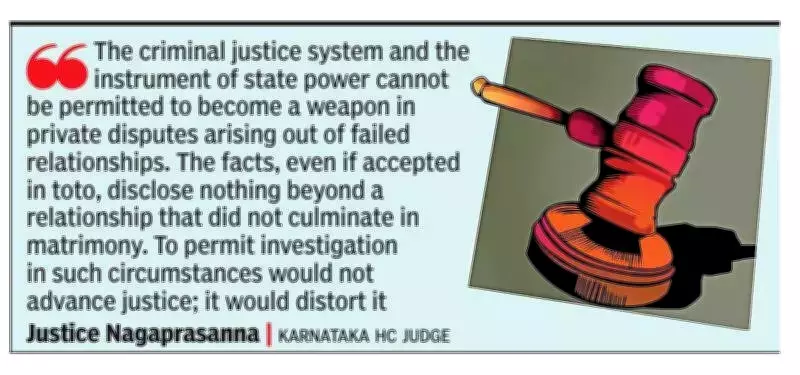
In a landmark judgment, the Karnataka High Court has strongly cautioned against turning broken relationships into criminal cases, stating that doing so would transform courts into "forums of personal vendetta rather than forums of justice." The court made this observation while quashing an investigation against a 35-year-old software professional from Surathkal in Dakshina Kannada district.
Legal Clarification on Bharatiya Nyaya Sanhita Section 69
The case centered on allegations under Section 69 of the Bharatiya Nyaya Sanhita (BNS), which penalizes inducing women into sexual intercourse through deceitful means, including false promises of marriage. Justice M Nagaprasanna, in his detailed order, emphasized that "time and again, the Supreme Court has clarified that consensual relationships between adults cannot be retroactively criminalized because one party withdraws from the relationship."
The judge elaborated that a promise of marriage becomes legally 'false' only when it is proven to be a "mere ruse, a deceitful stratagem, never intended to be honored." He clarified that subsequent factors such as a change of mind, emotional incompatibility, familial opposition, or mere reluctance do not constitute criminal intent from the beginning.

Background of the Relationship and Allegations
The narrative of this case began in Ireland in August 2021, where both the petitioner and the complainant were studying. The petitioner was pursuing a master's degree in international management at the National University of Ireland when they met. Their friendship evolved into a relationship, and after the petitioner secured employment, the couple started living together from December 2022.
However, the relationship deteriorated in mid-2024 when the petitioner discovered that the complainant was married and had a seven-year-old son. On October 19, 2024, after returning to India, the complainant filed a complaint at the women's police station in Mangaluru. She accused the petitioner of cheating her under the false promise of marriage, invoking Sections 69 and 115(2) of the BNS.
Contrasting Claims and Court's Findings
The petitioner, who challenged the FIR, argued that the complainant—five years his senior—had falsely alleged that he caused her to seek divorce from her husband, despite their marital issues predating their relationship. He maintained that their physical relationship was entirely consensual and that no promise of marriage was ever made.
Conversely, the complainant insisted that their intimacy was based on a promise of marriage held out by him. Justice Nagaprasanna meticulously examined the evidence, noting that the relationship spanned over two years in Ireland and was characterized by:
- Companionship and cohabitation
- Shared domestic life
- Consensual intimacy
The judge pointed out that there was no evidence of coercion, deception at inception, or force, as alleged. Instead, what followed was an allegation of betrayal, not violence. "It is trite that the law does not criminalize heartbreak," Justice Nagaprasanna asserted, leading to the quashing of the FIR against the petitioner on January 16, 2025, after a stay on the investigation was granted earlier.
Broader Implications for Legal Interpretation
This judgment reinforces critical legal principles regarding personal relationships and criminal law. It underscores that:
- Consensual adult relationships cannot be criminalized post-breakup.
- The burden of proof for a false promise of marriage requires demonstrating deceitful intent from the start.
- Courts must distinguish between personal grievances and genuine criminal offenses to prevent misuse of legal provisions.
The ruling serves as a significant precedent, protecting individuals from potential misuse of laws like BNS Section 69 in cases of relationship breakdowns, thereby upholding justice over vendetta.






