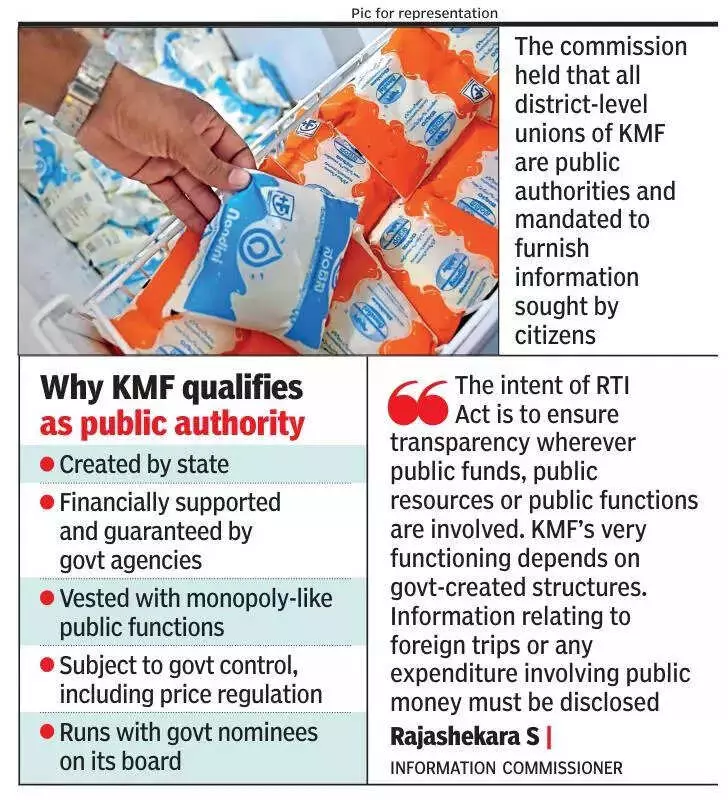
In a landmark decision that reinforces the public's right to know, the Karnataka Information Commission (KIC) has officially declared the Karnataka Milk Federation (KMF) and all its district-level unions as 'state' bodies, bringing them firmly under the ambit of the Right to Information (RTI) Act, 2005. This ruling mandates full transparency and requires these entities to furnish any information sought by citizens.
The Case That Led to the Ruling
The order was delivered by Information Commissioner Rajashekara S while adjudicating a second appeal filed by RTI applicant V Lokesh. Lokesh had sought specific details regarding an overseas tour undertaken by the managing director and other officials of the Kolar District Cooperative Milk Producers' Union (Komul). His initial application was filed on November 6, 2023, with the public information officer of the Kolar-Chikkaballapur Milk Union Limited.
In his decisive order, Commissioner Rajashekara anchored the ruling in a pivotal legal precedent. He cited a 1993 judgment from a three-judge bench of the Karnataka High Court in the case of KV Panduranga Rao vs Karnataka Dairy Development Corporation. In that verdict, dated October 22, 1993, the court had already classified KMF as a 'state' under Article 12 of the Indian Constitution. The KIC affirmed that this legal status leaves no room for ambiguity, making KMF and its affiliated unions fully accountable under the RTI framework.

Why KMF Qualifies as a Public Authority
The commission provided a detailed historical and functional analysis to support its conclusion. It traced the origins of Karnataka's dairy cooperative structure to the Karnataka Dairy Development Corporation (KDCC), a wholly government-owned entity established in 1974 to implement the World Bank-funded Operation Flood programme.
Following directives from the Indian Dairy Corporation and the Union government, the KDCC was later replaced with a cooperative model for Operation Flood II. This transition led to the formal incorporation of the Karnataka Milk Federation on January 10, 1983, under the Karnataka Cooperative Societies Act.
The order emphatically stated, "KMF did not arise in a vacuum. It is the product of a state decision, built on government assets, government programmes, and government-guaranteed finances." The commission detailed how KMF inherited all functions, assets, liabilities, and staff from the KDCC effective May 1, 1984.
Its early financial backbone consisted of a 30% grant from the Indian Dairy Corporation and a 70% loan, with the entire amount guaranteed by the Karnataka government, repayable at 8.5% interest over 15 years. Subsequent government orders transferred additional dairies, infrastructure, and equipment first to KMF and later to district unions like Bamul (Bangalore) and Komul (Kolar).
Implications for Transparency and Public Accountability
This ruling has far-reaching consequences. It means that citizens can now file RTI applications with KMF and its district unions, such as Bamul and Komul, to seek information on a wide array of matters. This includes details of officials' foreign trips, procurement policies, financial expenditures, and management decisions—essentially any operation involving public money or resources.
Commissioner Rajashekara underscored the core intent of the RTI Act, stating, "The intent of the RTI Act is to ensure transparency wherever public funds, public resources, or public functions are involved. KMF's very functioning depends on government-created structures. Information relating to foreign trips or any expenditure involving public money must be disclosed."
The commission also pointed to KMF's own bylaws, which authorize it to acquire government dairy undertakings, manage procurement and marketing, and develop dairy activities. "The functional, financial, and administrative control of the state is unmistakable," the order concluded.
This ruling sets a powerful precedent for transparency in cooperative institutions across Karnataka, ensuring that entities created by the state, funded by public money, and performing public functions remain answerable to the people they serve.