

Kolkata Witnesses First Flights to West Asia Since Conflict Erupted
In a significant development amid the ongoing war in West Asia, two aircraft took off from Kolkata for the region on Saturday. This marks the first such departures since hostilities broke out, signaling a tentative step towards resuming air travel connections that have been severely disrupted by the conflict.
Flight Operations Resume Amid Volatile Conditions
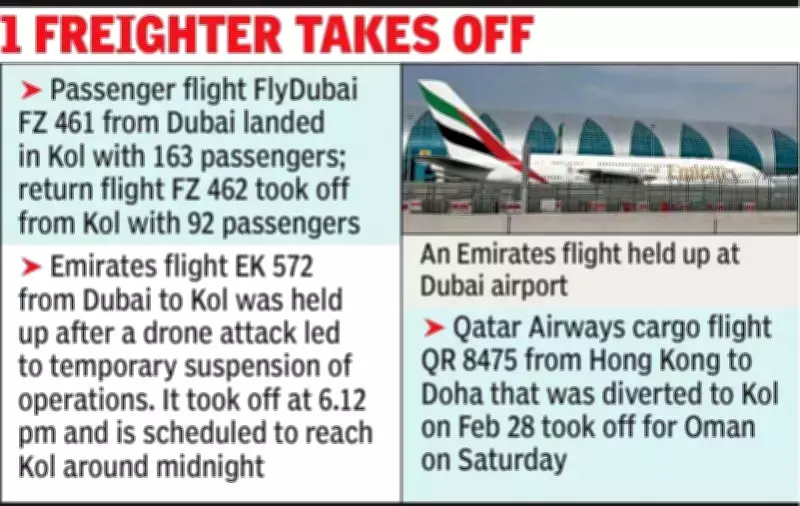
The two aircraft that departed included one passenger flight and one freighter aircraft. The count would have been three had operations not been temporarily suspended at Dubai International Airport following a drone attack near its main terminals. This incident forced the delay of an Emirates Airlines flight that was scheduled to reach Kolkata on Saturday evening.
The Emirates flight eventually took off later on Saturday evening, carrying over 200 passengers, and was expected to arrive in Kolkata around midnight. This disruption highlights the fragile nature of air travel resumption in the region, where security concerns continue to dictate flight schedules.

Passenger Movements and Cargo Operations
Earlier on Saturday, FlyDubai flight FZ 461 touched down in Kolkata at 12:53 AM, bringing back 163 passengers from the conflict zone. This represented only the second flight to reach the city from the war-affected area. On Thursday, another FlyDubai flight had returned with 130 passengers.
The return flight FZ 462 departed Kolkata at 1:59 AM with 92 passengers aboard. This represented a significant increase from Thursday's departing flight, which carried only 55 passengers, suggesting growing confidence among travelers despite the ongoing tensions.
In a separate development, a Qatar Airways Boeing B 777-200 cargo aircraft took off from Kolkata for Jeddah at 3:58 AM on Saturday. This freighter had been diverted to Kolkata on February 28 after airspace in Qatar was shut down following counter-strikes by Iran. Its departure followed what appeared to be improving conditions after Iran announced it would not target neighboring countries and apologized for recent attacks.
Traveler Experiences and Regional Impact
The conflict has created significant uncertainty for travelers. Govind Nag, a businessman from Bangur Avenue in Kolkata, shared his experience after returning with his wife and son via Hyderabad. "We were part of a 30-member group that reached Dubai on February 27 to tour the UAE until March 5," Nag recounted. "We just saw Burj Khalifa when the war broke out. Though Dubai functions normally during the day, it is tense thereafter, with sirens going off, warning of drone or missile attacks. The streets would be deserted."
Nag managed to book tickets on an Etihad flight from Abu Dhabi to Hyderabad on Friday, but at least 12 other holidayers from his group remained booked on the delayed Emirates flight to Kolkata, facing continued uncertainty about their return.
Broader Implications for Kolkata Air Travel
The war's disruption has particularly impacted Kolkata, as explained by Travel Agents Association of India chairman (East) Anjani Dhanuka. "The war disrupted travel everywhere, but it hit Kolkata more than other major cities as there are no direct flights to Europe and the US from here," Dhanuka noted.
With five airlines—Emirates, Etihad, Qatar Airways, FlyDubai, and Air Arabia—operating 34 flights weekly between Kolkata and Gulf hubs, most travelers to the region and onward to Europe and the United States depend on these carriers. The suspension of these services has created significant travel bottlenecks.
An official from a Gulf carrier emphasized that while airlines are eager to resume normal operations, airspace safety remains the determining factor for whether flights will operate or continue to be cancelled. Early flight movements from Abu Dhabi and Dubai on Saturday had raised hopes of gradual normalization of services between Kolkata and West Asian hubs including Dubai, Abu Dhabi, and Doha.
The situation remains fluid, with the temporary suspension at Dubai airport following the drone attack serving as a reminder that air travel resumption in the region will likely proceed in fits and starts as security conditions evolve.






