

Kolkata High Court Revokes Bail in Developer Fraud Case, Emphasizes Victim Safety
The Calcutta High Court on Friday took a firm stance by cancelling the bail of a developer accused of cheating and threatening an elderly widow involved in a property redevelopment project. Justice Uday Kumar, presiding over the case, highlighted that the Sealdah court's initial bail grant had improperly prioritized the accused's liberty over the victim's safety, leading to a critical judicial review.
Case Background and Allegations
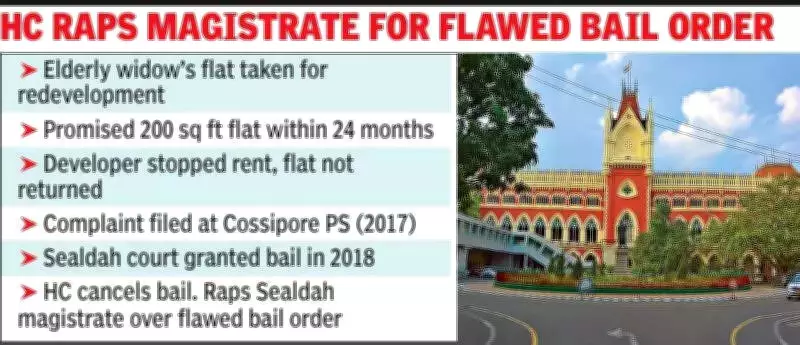
The victim, a lawful tenant residing at 34C, Gopal Chandra Chatterjee Road in Kolkata, entered into a tripartite development agreement in 2011 with Sree Krishna Construction. According to the agreement and a subsequent undertaking dated November 26, 2014, the developer was obligated to relocate the widow to temporary accommodation, cover her monthly rent, and reinstate her in a self-contained 200 sq ft flat within 24 months. However, after taking possession of her residence for redevelopment, the accused ceased payments and failed to deliver the promised flat, prompting the victim to file a formal complaint at Cossipore Police Station in 2017.
Arrest and Initial Bail Grant
The accused was arrested on May 3, 2018, but was granted bail just four days later by the additional district judicial magistrate in Sealdah. The magistrate cited the "period of detention and absence of any mention of threat in the remand report" as reasons for the bail decision. This move sparked controversy, as it overlooked significant threats reported by the victim.

High Court's Critical Observations
Justice Kumar strongly criticized the Sealdah court's reasoning, describing it as a "superficial assessment of the gravity of the matter." He emphasized that in cases involving white-collar crimes and criminal breach of trust, protecting the victim and preserving evidence integrity should be paramount. The court noted that the magistrate failed to address the victim's complaints of threats made on May 4, 2018, prior to the bail grant, and subsequent death threats reported on May 21 and 22.
In his ruling, Justice Kumar stated, "The liberty of an accused, while precious, cannot be protected by an order that is ‘born in sin', that is, an order passed in defiance of the High Court's administrative and judicial discipline." This underscored the need for adherence to legal protocols in bail proceedings.
Procedural Lapses and Judicial Accountability
The High Court also pointed out procedural lapses in the bail order, which was either unsigned or only partially initialled by the judicial officer. Justice Kumar remarked, "A ‘mere initial' on a bail order in a case involving substantial fraud... undermines the solemnity of judicial proceedings." To address this, the court directed the Registrar (judicial services) to seek an explanation from the judicial officer and include the order in the officer's Annual Confidential Report dossier along with a formal warning, ensuring accountability for future cases.
Protective Measures for the Victim
In addition to cancelling the bail, Justice Kumar ordered the Kolkata police commissioner to provide protection to the elderly widow and her family, reinforcing the court's commitment to victim safety in judicial processes. This directive aims to prevent further intimidation and ensure the victim's well-being during the ongoing legal proceedings.
This case highlights the judiciary's evolving approach to balancing accused rights with victim protection, particularly in fraud and threat scenarios, setting a precedent for stricter bail considerations in similar future instances.






