Madras High Court Issues Urgent Directive for Lung Transplant Decision
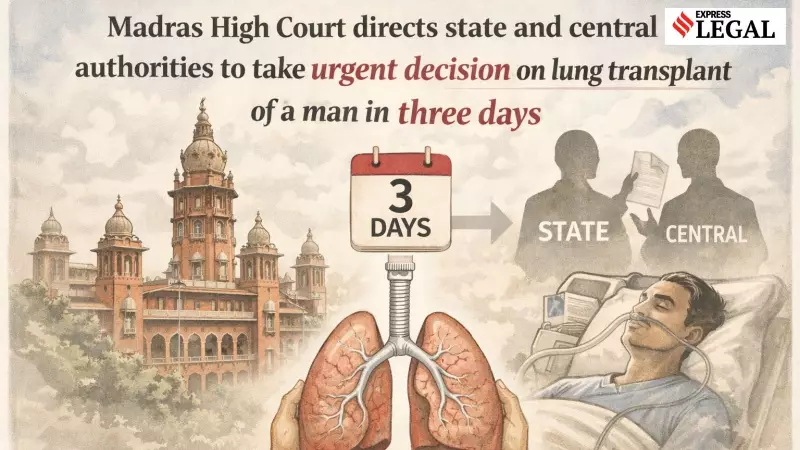
The Madras High Court has taken swift action in a life-or-death medical case. Justice P T Asha has directed national and state organ transplant authorities to make a decision within just three working days regarding priority allocation of a dual lung transplant for a critically ill patient.
Critical Condition Prompts Judicial Intervention
Rajni Singh approached the court with an urgent petition concerning her husband's deteriorating health. Her husband currently receives treatment at Apollo Hospitals in Chennai for severe lung disease. Medical reports indicate his condition has reached a critical stage that demands immediate transplantation to save his life.
The petitioner sought what medical professionals term "super-emergent" consideration for organ allocation. This designation would place her husband at the front of the waiting list when suitable lungs become available.

Court's Specific Directions to Transplant Authorities
In her January 9 order, Justice Asha issued clear instructions to two key organizations:
- The National Organ and Tissue Transplant Organization (NOTTO)
- The Transplant Authority Government of Tamil Nadu (TRANSTAN)
The court directed these authorities to consider the petitioner's request positively and make a formal decision within three working days. The order specifically references a communication sent to NOTTO on January 1, 2026, which detailed the patient's life-threatening situation.
Legal Arguments Highlight Urgency
Advocate N S Tanvi, representing the petitioner, presented compelling arguments before the court. She emphasized that despite the January 1 communication clearly outlining the medical emergency, authorities had not taken prompt action.
The legal counsel stressed that any delay could prove irreversible. The progressive nature of the lung disease creates a narrow window for successful transplantation. Every passing day reduces the chances of a positive outcome.
Broader Context of Organ Transplantation in India
This case unfolds against a challenging backdrop for organ transplantation in India. Recent data reveals that nearly 3,000 Indians died while waiting for organs over a five-year period. Currently, over 82,000 patients remain on various transplant waitlists across the country.
The court's intervention highlights the tension between established allocation policies and genuine medical emergencies. Justice Asha specifically noted that her order did not delve into the merits of existing transplant policies or medical assessments. Instead, she focused exclusively on the imminent threat to life presented by this particular case.
What Happens Next
NOTTO and TRANSTAN must now review the petitioner's request with urgency. The three-day deadline creates pressure for a swift administrative decision. When suitable donor lungs become available, authorities must give priority consideration to this critically ill patient.
This judicial directive demonstrates how courts can intervene in healthcare emergencies when bureaucratic processes move too slowly. The outcome could set an important precedent for how transplant authorities handle similar urgent cases in the future.
The patient remains hospitalized in Chennai, with medical teams prepared to proceed with transplantation should organs become available. His family continues to hope for a positive resolution within the court-mandated timeframe.