

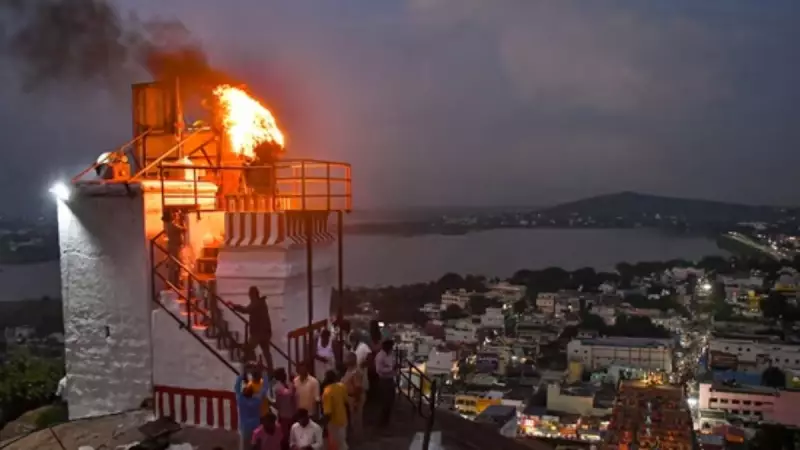
In a significant ruling emphasizing communal harmony and religious freedom, the Madras High Court has upheld a previous order permitting the lighting of a traditional lamp near the revered Thirupparankundram dargah in Madurai during the Deepavali festival. This decision brings a legal resolution to a longstanding and sensitive issue that had sparked debate in the region.
The Legal Challenge and Court's Verdict
The controversy reached the judiciary when a writ petition challenged a single judge's order from November 2023. The original order had allowed the lighting of the lamp, known as 'kuthuvilakku,' on a platform located approximately 150 feet from the dargah's entrance. A division bench comprising Justice S M Subramaniam and Justice V Lakshminarayanan heard the appeal against this order.
After careful consideration, the bench dismissed the appeal, thereby validating the single judge's decision. The court's ruling was grounded in the principle that the act of lighting a lamp is a peaceful religious observance. The judges noted that the platform in question was on public land and the practice had historical precedence, having been observed for many years without incident.

Details of the Original Order and Conditions
The initial order, passed by the single judge, came with specific conditions to ensure the event's peaceful conduct. The authorities were directed to permit the lamp lighting for a duration of five days surrounding the Deepavali festival. Crucially, the order mandated that the event must be conducted without any form of procession, music, or loudspeaker usage that could be deemed provocative.
The court emphasized that the right to practice one's religion is fundamental, provided it does not infringe upon the rights of others or disturb public order. By setting these clear boundaries, the judiciary aimed to balance religious expression with communal peace. The location of the platform, at a distance from the dargah's main entrance, was also a factor in the decision, intended to minimize any potential for conflict.
Implications for Communal Harmony
This ruling by the Madras High Court is being viewed as a strong endorsement of India's pluralistic fabric. It sends a clear message about the coexistence of diverse religious practices within shared public spaces. The court underscored that peaceful religious ceremonies, when conducted within the framework of the law, must be protected.
The decision is expected to set a precedent for handling similar interfaith sensitivities in other parts of the country. It reinforces the legal view that the state's role is to facilitate peaceful observance while preventing any action that could lead to discord. For the residents of Madurai and the devotees of the Thirupparankundram dargah, this judgment provides a clear legal pathway for continuing a long-held Deepavali tradition while maintaining the sanctity and peace of the dargah premises.
The resolution of this case through the judicial process highlights the importance of dialogue and legal frameworks in resolving community-based issues. It stands as a testament to the judiciary's role in upholding constitutional values while navigating complex socio-religious landscapes.






