

MP High Court Rebukes Principal Secretary for Allegedly Shielding Delinquent Officer
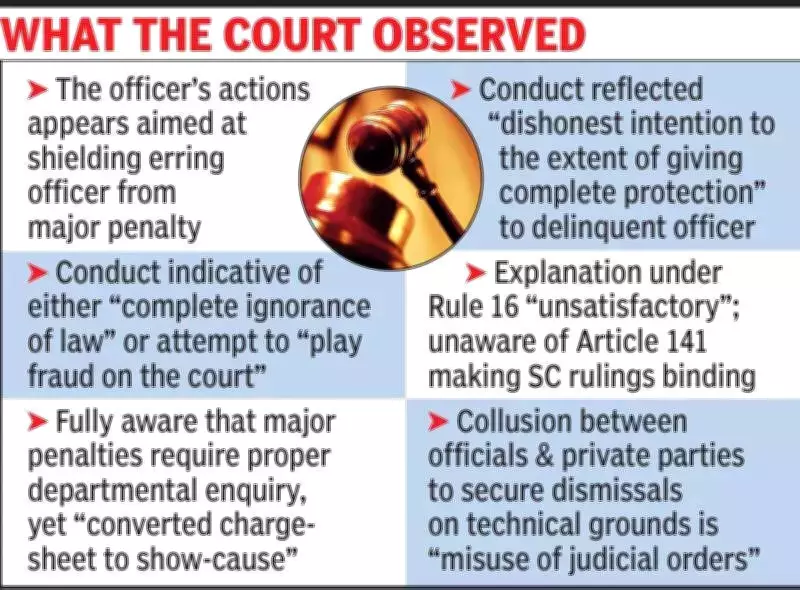
The Madhya Pradesh High Court bench at Gwalior has issued a stern rebuke to Principal Secretary of the General Administration Department (GAD), M Selvendran, over his handling of a disciplinary case. The court observed that Selvendran's actions seemed deliberately designed to protect an erring officer from facing a major penalty, with the judge at one point characterizing his conduct as indicative of either "complete ignorance of law" or an attempt to "play fraud on the Court."
Court Records Admissions and Questions Legal Awareness
During the hearing of MCC No. 278 of 2013 (State of MP vs Amar Singh & Others) on March 18, Justice G S Ahluwalia documented that Selvendran, who appeared in person, acknowledged that after issuing a departmental charge-sheet and finding the officer's defense unsatisfactory, he bypassed a full-fledged departmental enquiry. Instead, he imposed only a minor penalty of stoppage of one increment without cumulative effect.
The court noted that Selvendran was fully aware that major penalties cannot be imposed without a proper departmental enquiry under established rules. Despite this knowledge, he chose to convert the charge-sheet into a mere show-cause mechanism, effectively insulating the delinquent officer from harsher punishment. Justice Ahluwalia remarked that this behavior reflected a "dishonest intention to the extent of giving complete protection" to the official in question.

Unsatisfactory Justifications and Constitutional Ignorance Highlighted
In the proceedings, Selvendran attempted to justify his decisions under Rule 16 of the MP Civil Services (Classification, Control and Appeal) Rules, asserting there was no mala fide intent. However, the court found his explanations wholly unsatisfactory and raised further alarms about his apparent lack of awareness regarding Article 141 of the Constitution. This article mandates that the law declared by the Supreme Court is binding on all authorities across India.
The bench expressed deep concern that a senior officer of the rank of Principal Secretary seemed unaware of a critical Supreme Court ruling in State of MP Vs Ram Kumar Chaudhary (dated November 29, 2024). This ruling explicitly states that delays caused by officials must be penalized with substantial punishment, not with superficial "eye wash" penalties. The judge pointed out that more than a year had elapsed since this ruling, yet no compliance or even basic awareness was demonstrated by Selvendran.
Admission of Granting "Clean Chit" and Protective Actions
In a significant development during the hearing, Selvendran admitted before the court that his decision had the practical effect of granting a "clean chit" and shielding the officer from a major penalty. He further conceded that he had failed to properly consider the serious consequences of circumventing a mandatory departmental enquiry process.
Court Grants Final Opportunity for Rectification
While the court made these strong observations, it refrained from passing immediate strictures against Selvendran. Instead, it granted him one final opportunity to correct his actions and demonstrate accountability. The court directed him to place on record, within one week, the specific steps he proposes to take to rectify the situation. This includes ensuring that erring officers cannot misuse procedural lapses to escape appropriate accountability for their actions.
The High Court also issued a cautionary note, warning that collusion between government officials and private parties to secure dismissal of cases on purely technical grounds amounts to a misuse of judicial orders. Such actions, the court stated, effectively use legal processes as a shield to protect wrongdoing rather than to deliver justice.
Next Hearing Scheduled with Directions
The matter has been listed for further hearing on March 25, 2026, at 10:30 AM. The court has directed Selvendran to file a detailed affidavit outlining the corrective measures he intends to implement. For this upcoming hearing, his personal appearance has been exempted, though the court expects full compliance with its directives.






