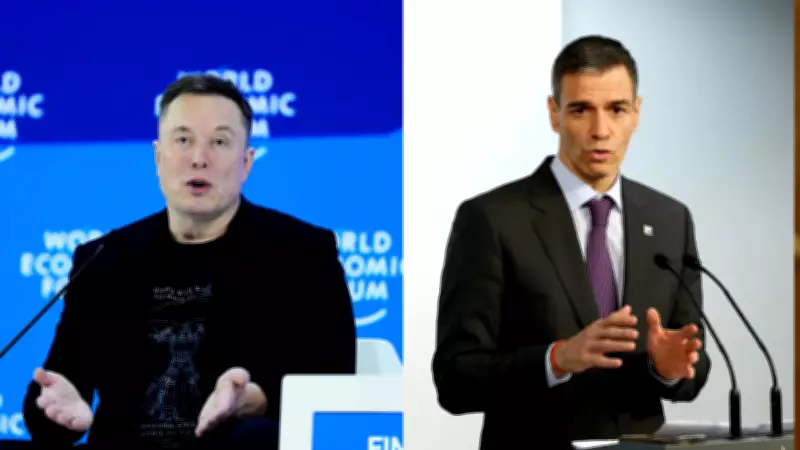
Elon Musk Launches Furious Attack on Spanish PM Over Proposed Social Media Ban for Minors
In a dramatic escalation of tensions between tech billionaires and European governments, Elon Musk has unleashed a sharp verbal assault on Spanish Prime Minister Pedro Sánchez. The controversy erupted after Spain proposed banning children under 16 from using social media platforms, a move aimed at curbing harmful and hateful online content while tightening regulation of technology companies.
Spain's Bold Proposal to Protect Children from the 'Digital Wild West'
The proposed ban forms part of a broader package of digital protection measures being prepared by Sánchez's government to safeguard minors online. Speaking at the World Governments Summit in Dubai, Sánchez declared that urgent action was necessary to shield children from what he described as the 'digital wild west'.
'Social media has become a failed state where laws are ignored and crimes are tolerated,' Sánchez stated emphatically. 'Our children are exposed to a space they were never meant to navigate alone. We will no longer accept that. We will protect them from the digital wild west.'
The ban would be implemented through amendments to an existing bill on digital protection for minors currently under parliamentary debate, according to government spokespersons.
Musk's Explosive Response: 'Tyrant' and 'Fascist Totalitarian'
Responding on his social media platform X, Musk launched an extraordinary personal attack on the Spanish leader. Initially calling Sánchez a 'tyrant', Musk escalated his criticism dramatically within hours.
'Dirty Sánchez is a tyrant and a traitor to the people of Spain,' Musk posted, followed approximately 90 minutes later with: 'Sánchez is the true fascist totalitarian.'
The Tesla and SpaceX CEO's outburst represents one of his most direct confrontations with a European government leader over digital regulation policies.
Europe-Wide Crackdown on Children's Social Media Access
Spain's initiative reflects a broader hardening of attitudes across Europe regarding children's social media usage:
- Greece is reportedly close to announcing a similar ban for children under 15
- Britain and France are actively considering tougher regulatory measures
- Australia became the first country to prohibit social media access for under-16s in December
Sánchez revealed that Spain belongs to a coalition of six European nations – which he termed a 'coalition of the digitally willing' – seeking to coordinate cross-border digital regulation, though he declined to name the other participating countries.
Tech Industry Response and Expert Opinions
Major technology companies maintained silence initially, with representatives from Google, TikTok, Snapchat, and Meta not immediately responding to requests for comment on Spain's proposals.
Diana Diaz, director of the ANAR Foundation for at-risk children and adolescents, welcomed the regulation, stating it would 'give parents clearer backing to set limits and ease social pressure on children worried about missing out.'
However, Jose Cesar Perales, a professor of experimental psychology at the University of Granada, cautioned that 'there was no unanimous agreement that social media harms adolescents,' highlighting ongoing academic debate about the precise impacts of social media on youth development.
AI Concerns Intensify the Debate
The controversy has gained additional urgency following reports about AI-generated content, including allegations that Musk's own Grok chatbot produced non-consensual sexual images, some involving minors. Sánchez announced that Spanish prosecutors would explore possible legal violations by Grok, as well as by TikTok and Instagram.
Strong Public Support for Restrictions
Public opinion appears firmly behind stricter measures, according to recent polling data. An Ipsos survey published in August last year revealed that 82% of Spaniards believed children under 14 should be banned from social media, representing a significant increase from 73% support recorded in 2024.
This growing public consensus suggests that European governments may face relatively little domestic opposition as they pursue more aggressive digital regulation, despite fierce criticism from tech industry leaders like Musk.
The confrontation between Musk and Sánchez highlights the deepening divide between Silicon Valley's libertarian ethos and European governments' increasing determination to regulate digital spaces, particularly where child protection is concerned. As Europe moves toward more comprehensive digital governance frameworks, similar clashes between tech titans and policymakers seem likely to multiply across the continent.