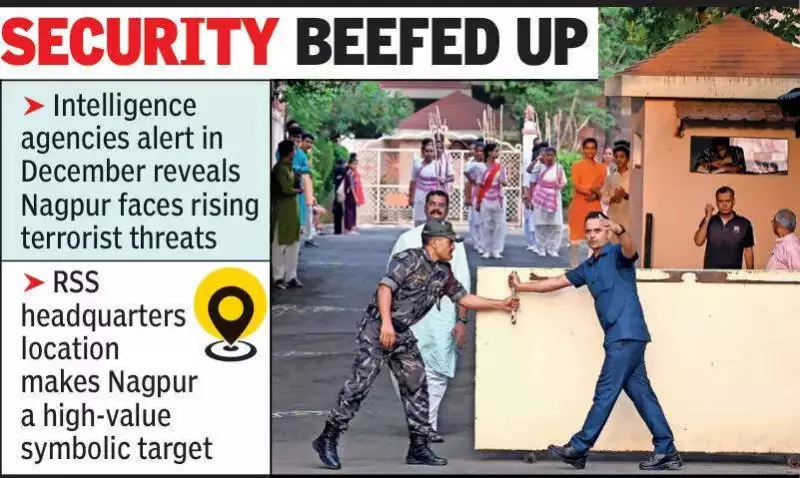
India's central intelligence agencies have placed Nagpur among the country's top three cities most vulnerable to terror attacks, ranking it just behind Delhi and Mumbai. This alarming classification comes ahead of New Year celebrations, with security forces implementing a stringent, multi-layered security blanket across the city.
Nagpur's High-Value Targets on Terror Radar
The Rashtriya Swayamsevak Sangh (RSS) headquarters in the Mahal area has been specifically identified as a high-priority symbolic target for Pakistan-based terror outfits, primarily Jaish-e-Mohammed (JeM). Intelligence intercepts have repeatedly mentioned the RSS headquarters and the Dr. Hedgewar Smruti Mandir (Hedgewar Memorial) in Reshimbagh, located 2.2 km away, as potential targets.
Security sources indicate that JeM's intensified focus on such sensitive locations is seen as a direct attempt at retaliation for India's precision strikes in Pakistan during Operation Sindoor earlier this year. The aim of these potential attacks, as per intelligence, is to create communal unrest through sleeper cells.

Nationwide Alert Triggers Massive Security Overhaul
Following the December alert from central agencies, Nagpur has witnessed a significant ramp-up in security measures. Key installations under the security blanket include:
- Nagpur airport and all major railway stations.
- All arterial routes and interstate border points.
- Hotels, lodges, guest houses, and resorts.
Security forces have deployed bomb detection squads, Quick Response Teams (QRTs), and anti-sabotage units. Drone surveillance and no-fly zones have been enforced around vulnerable sites, supported by facial recognition systems for enhanced monitoring. Vehicular checks and 'nakabandi' operations are in full swing to prevent infiltration.
Public Cooperation Crucial in Thwarting Threats
An official stated that authorities are "leaving no stone unturned" but emphasized that public cooperation is vital. Security agencies plan to use public address systems to broadcast alerts, urging citizens not to touch any suspicious objects and to immediately dial 112 for emergencies.
Security experts note that Nagpur's inclusion in the top three hotspots underscores the shifting dynamics of terrorism, where ideological and symbolic targets are at increasing risk. The pattern of threats is linked to JeM's activities post-Operation Sindoor, with recent incidents like blasts in Delhi amplifying concerns. A coordinated effort by the state Anti-Terrorism Squad (ATS), central agencies, and local police is now underway to secure the city.