

In a significant judgment that reinforces established legal principles on caste verification, the Nagpur bench of the Bombay High Court has granted Scheduled Tribe (ST) validity certificates to two siblings from Buldhana district. This ruling came despite the fact that their father's caste claim had been rejected earlier.
Court Overrules Scrutiny Committee's Decision
The division bench, comprising Justices Mukulika Jawalkar and Raj Wakode, set aside an order dated March 16, 2022, from the Scheduled Tribe Caste Certificate Scrutiny Committee in Amravati. The committee had invalidated the claims of Ankit Ingle (27) and Snehal Bhuyar (29), who sought recognition as members of the 'Thakur' scheduled tribe.
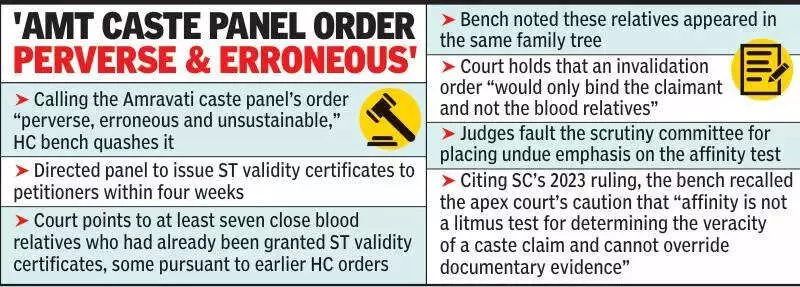
The court declared the committee's reasoning as "patently erroneous." The bench emphasized that the rejection of a parent's caste claim does not automatically bind the children, especially when substantial documentary evidence and validity certificates from close blood relatives are presented.

Documentary Evidence and Legal Precedent Prevail
The high court's decision was based on a robust body of evidence. The petitioners submitted as many as 28 documents, including pre-Independence records from 1930 and 1937 that consistently recorded the caste entry as "Thakur." Key among these were a 1943 admission register of their grandfather and a 1930 birth-death extract of their great-grandfather.
Furthermore, the court noted that at least seven close blood relatives—including uncles and cousins—had already been granted ST validity certificates, some pursuant to earlier high court orders. These relatives were part of the same documented family tree.
Reiterating settled law, the bench stated that an invalidation order "would only bind the claimant and would not bind the blood relatives, for the simple reason they are not parties to such adjudication." It added that the father's failure to challenge his own 2012 invalidation did not preclude his children from substantiating their independent claim.
Affinity Test Cannot Override Documentary Proof
The judges strongly criticized the scrutiny committee for placing undue emphasis on the failure of the affinity test. Citing a 2023 Supreme Court ruling in the case of Maharashtra Adivasi Thakur Jamat Swarakhshan Samiti versus State of Maharashtra, the bench recalled the apex court's caution.
The Supreme Court had noted that "affinity is not a litmus test" for determining a caste or tribe claim and cannot override concrete documentary evidence. The high court also rejected the committee's argument regarding the petitioners' village location being outside a previously notified area for the Thakur tribe.
Calling the Amravati committee's order "perverse, erroneous and unsustainable," the bench quashed it entirely. The court directed the committee to issue Scheduled Tribe validity certificates to both petitioners within four weeks. The siblings, both students, had originally obtained their ST certificates from the sub-divisional officer in Buldhana in 2018, which were later referred for verification by their educational institutions in 2020.






