

Nagpur High Court Clarifies Maintenance Law: Parents' Financial Status Irrelevant
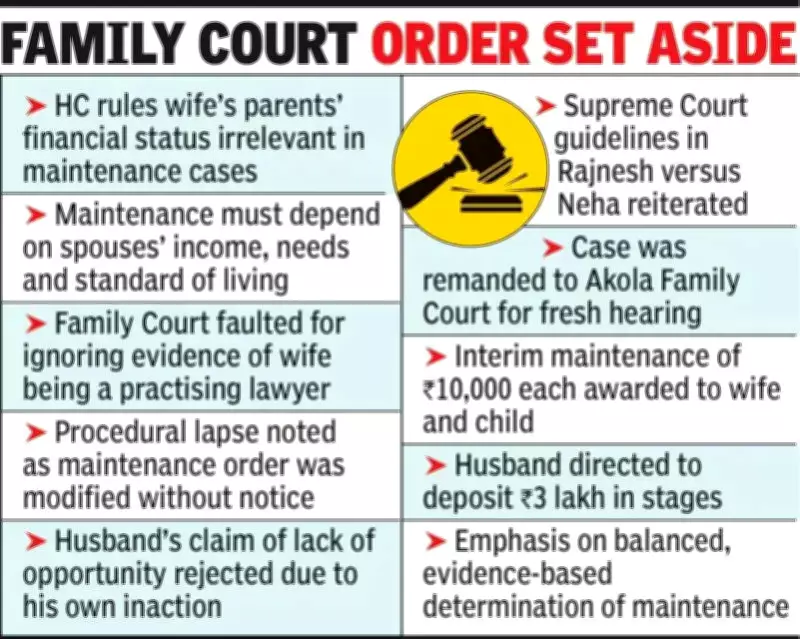
The Nagpur bench of the Bombay High Court has delivered a significant ruling that fundamentally reshapes how maintenance is determined in matrimonial disputes. In a landmark judgment last month, the court declared that the financial position of a wife's parents holds no relevance when calculating maintenance payments, setting aside a previous order from the Akola family court.
Procedural Lapses and Overlooked Evidence
Justice Urmila Joshi Phalke, while allowing a criminal revision application, found that the family court had committed serious errors by ignoring crucial evidence regarding the wife's income and failing to follow proper procedural safeguards. "What must be assessed is whether the claimant spouse has sufficient independent income to sustain herself," the court emphasized, clarifying that interim maintenance depends entirely on financial necessity rather than family background.
The case originated from a challenge by a Baroda-based man employed in South Africa against a November 2023 family court order that directed him to pay 18,000 rupees monthly to his wife and 10,000 rupees to their minor daughter. The high court discovered that despite clear records showing the wife was enrolled with the Bar Association and had appeared in multiple cases as a practicing lawyer, "this aspect was not considered by the family court while calculating the amount of maintenance."

Court's Detailed Guidelines for Maintenance Assessment
Justice Joshi Phalke provided comprehensive guidelines for how maintenance should be determined:
- Courts must evaluate the husband's financial status and earning capacity
- The standard of living the wife was accustomed to in her matrimonial home must be considered
- Reasonable needs including food, clothing, shelter, education and medical expenses must guide the determination
- Independent income, assets, dependents and liabilities of both parties require assessment
- A wife's earning status alone cannot disqualify her from receiving maintenance
The judge stressed that the key question is whether the wife's income is sufficient to maintain the same standard of living she enjoyed during the marriage, not whether she has any income at all.
Procedural Irregularities and Remand Order
The high court identified multiple procedural lapses in the family court's handling of the case. Notably, the family court had modified the maintenance amount without issuing proper notice to the husband, violating fundamental principles of natural justice. However, the court also rejected the husband's claim of lacking opportunity, observing that he had failed to cross-examine the wife when given the chance.
Relying on the Supreme Court's precedent in Rajnesh vs. Neha, Justice Joshi Phalke reiterated that maintenance aims to prevent destitution and must be determined through a balanced, evidence-based assessment. The matter has been remanded to the Akola family court for fresh adjudication, with both parties granted liberty to present additional evidence.
Interim Relief and Financial Safeguards
Pending the reconsideration, the high court directed the husband to provide interim financial support. Specifically, he must pay 10,000 rupees each to his wife and child monthly and deposit 3 lakh rupees in stages to ensure they are not deprived of essential support during the legal proceedings. This interim arrangement reflects the court's commitment to preventing hardship while proper assessment occurs.
The ruling establishes important legal principles that will influence future maintenance cases across Maharashtra and potentially beyond. By emphasizing that maintenance must be rooted in the financial capacity and needs of the spouses themselves—completely independent of their parents' wealth—the judgment brings greater clarity and fairness to this sensitive area of family law.






