

Nagpur High Court Raises Alarm Over Deekshabhoomi Redevelopment Project
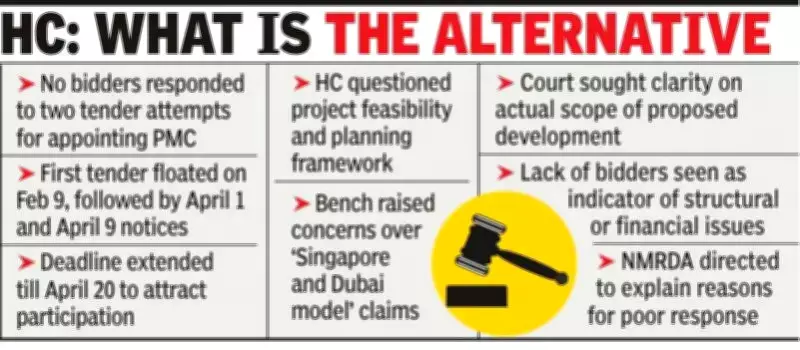
The Nagpur bench of the Bombay High Court has expressed profound concerns regarding the feasibility and planning of the proposed redevelopment of Deekshabhoomi, a site of immense national and international significance. This development comes after repeated tendering processes for appointing a project management consultant (PMC) failed to attract a single bidder, prompting the court to scrutinize the entire initiative's viability.
Multiple Tender Failures Prompt Judicial Scrutiny
During a hearing of a Public Interest Litigation (PIL) filed by lawyer Shailesh Narnaware, a division bench comprising Justices Anil Kilor and Raj Wakode sought detailed explanations from the Nagpur Metropolitan Region Development Authority (NMRDA) and the state government. The court was informed that the initial tender for the PMC was floated on February 9, but received no response. Subsequent advertisements on April 1 and April 9 also yielded no bids, leading to an extension of the deadline until April 20 in a desperate attempt to elicit participation.
Advocate Girish Kunte, representing NMRDA, presented these facts before the bench. The court, visibly dissatisfied, emphasized that merely issuing tenders without ensuring project feasibility is insufficient for a venture of such monumental importance.

Court Questions "Singapore and Dubai" Model Claims
The issue gained further prominence as the state government had previously informed the court that the redevelopment would be modeled on global urban paradigms like Singapore and Dubai. However, the bench expressed significant reservations about these claims, demanding concrete details on their practical implementation.
"What kind of development is being proposed on the lines of Singapore and Dubai?" the court questioned orally, underscoring the critical need for specificity and clarity in the planning stages. This judicial inquiry highlights a gap between ambitious declarations and tangible, actionable plans.
Background of Delays and Committee Decisions
The petition brought to light ongoing delays and disputes surrounding the Deekshabhoomi redevelopment. The site, which attracts thousands of visitors annually, has been mired in procedural complexities. The court was informed that a meeting held on January 16, involving district authorities, NMRDA, the Nagpur Improvement Trust, and members of the memorial committee, had shortlisted one of four development options.
Furthermore, the state placed on record a communication referencing a meeting chaired by the social justice minister on December 11, 2025. This meeting stated that proposals would be invited to ensure an "international-standard" development. NMRDA submitted that the tendering process was initiated in accordance with these directives. Despite these procedural steps, the complete absence of bidders has drawn the court's sharp attention.
Judicial Directives for Alternative Measures
Expressing clear dissatisfaction with the current impasse, the bench directed NMRDA to outline alternative measures to move the project forward. "If no contractor is coming forward, what is the alternative?" the court asked, emphasizing the necessity to identify and address the underlying issues deterring potential bidders.
The court has mandated NMRDA to file a comprehensive reply addressing the future course of action. This directive aims to ensure that the project does not remain stalled due to administrative or planning inadequacies. The matter is scheduled for a further hearing on April 18, where these responses will be critically examined.
The ongoing judicial oversight underscores the high stakes involved in the Deekshabhoomi redevelopment, a project that holds deep cultural, historical, and religious significance. The court's interventions seek to inject accountability and practical rigor into a process that has so far been marked by ambition but lacking in execution.






