

Nagpur High Court Reinforces Maintenance Laws: Wife's Employment Not Ground for Denial
The Nagpur bench of the Bombay High Court delivered a significant verdict last week, strengthening the legal framework for maintenance claims. The court explicitly held that "merely because the wife was earning, it could not be a ground to reject her claim for maintenance." This ruling came while dismissing a criminal revision application filed by a husband challenging a 2023 family court order from Yavatmal.
Case Background and Court's Rationale
Justice Urmila Joshi-Phalke upheld the family court's decision directing the husband to pay Rs 2,000 each per month to his wife and their minor son. The judge emphasized that the primary objective of Section 125 of the Code of Criminal Procedure (CrPC) is to prevent destitution and vagrancy. Financial capability, the court noted, must be assessed in the context of sustaining a reasonable standard of living, not merely based on employment status.
The case stemmed from a matrimonial dispute between a couple married in November 2019, with a son born in August 2020. The wife alleged sustained mental cruelty, neglect during pregnancy, and abandonment after childbirth, which compelled her to seek maintenance and restitution of conjugal rights.

Husband's Arguments and Court's Rebuttal
The husband opposed the plea, arguing that his wife was employed as an assistant professor with a substantial salary, making her financially independent. He contended she had voluntarily withdrawn from matrimonial life and was thus not entitled to maintenance.
However, the High Court, after thorough examination of evidence, found that the wife's employment was temporary and lacked stability. The court reiterated principles established by the Supreme Court in multiple precedents, underscoring that temporary income does not equate to financial independence.
Justice Joshi-Phalke also observed that the husband had failed to disclose his income, stating, "An able-bodied husband must be presumed to be capable of earning sufficient money to maintain his wife and children." The judgment added that adverse inference can be drawn if income details are withheld, highlighting the husband's attempt to evade responsibility by claiming financial incapacity.
Evidence of Marital Discord and Neglect
On the issue of marital discord, the court accepted the wife's account of consistent humiliation and lack of support during and after pregnancy. It held that such conduct established "neglect and refusal" on the part of the husband, forming a valid basis for maintenance under the law.
The judgment further clarified that even if a wife has some income, it must be sufficient to maintain a standard of living comparable to that in the matrimonial home. In this instance, the modest sum awarded by the family court was deemed "reasonable, just and proper," especially considering rising living costs and the child's needs, including educational expenses.
Key Takeaways from the High Court Verdict
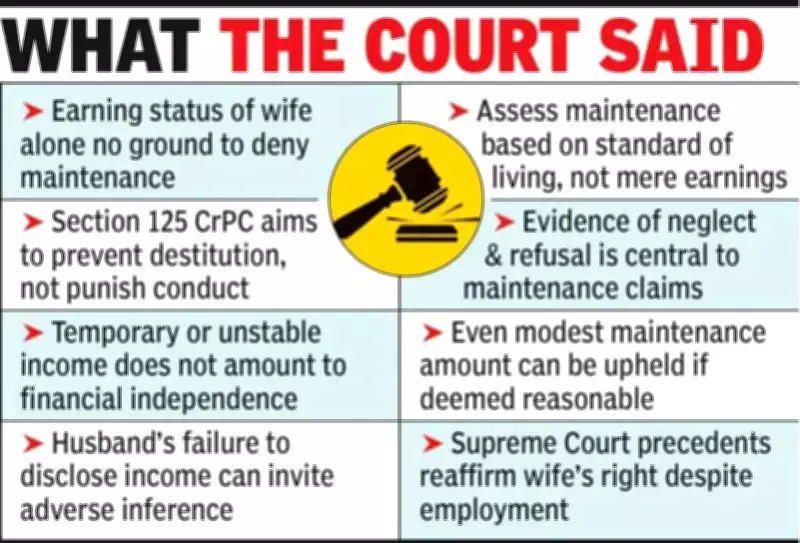
- Earning status of wife alone is no ground to deny maintenance.
- Section 125 CrPC aims to prevent destitution, not punish conduct.
- Temporary or unstable income does not amount to financial independence.
- Husband's failure to disclose income can invite adverse inference.
- Assess maintenance based on standard of living, not mere earnings.
- Evidence of neglect & refusal is central to maintenance claims.
- Even modest maintenance amounts can be upheld if deemed reasonable.
- Supreme Court precedents reaffirm wife's right despite employment.
Dismissing the revision application, the court upheld the maintenance order, emphasizing that social welfare provisions cannot be diluted by a narrow interpretation of a woman's earning capacity. This ruling reinforces the protective intent of maintenance laws, ensuring financial security for spouses and children in matrimonial disputes.






