

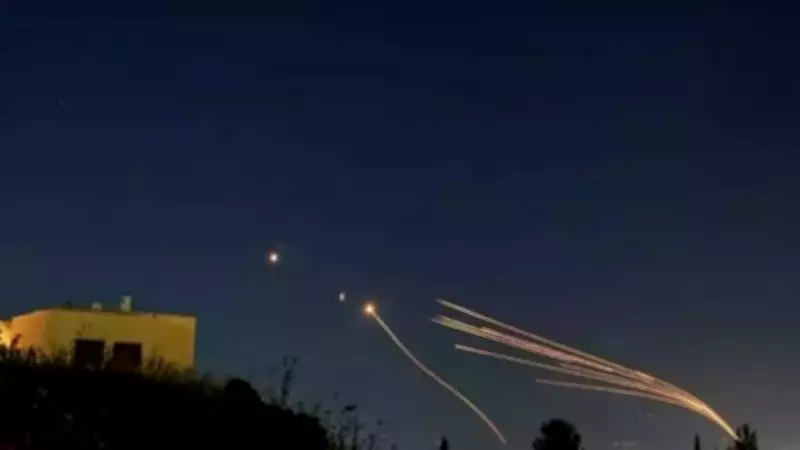
NATO Air Defense Systems Intercept Iranian Ballistic Missile Heading Toward Turkish Airspace
In a significant escalation of the ongoing regional conflict, Turkey announced on Wednesday that NATO air and missile defense systems successfully destroyed a ballistic missile launched from Iran that was traveling toward Turkish airspace. This incident marks the first direct impact of the expanding confrontation on a NATO member country, raising tensions in an already volatile region.
Details of the Interception and Turkish Response
According to the Turkish Defence Ministry, the missile was intercepted by NATO defense systems stationed in the eastern Mediterranean after it traveled over Syria and Iraq and approached Turkish airspace. The ministry confirmed that there were no casualties or injuries resulting from the incident, but debris from the air defense missile used during the interception fell in the Dortyol district of Hatay province in southeastern Turkey.
Turkish authorities issued a stern warning following the interception. "We warn all parties to refrain from actions that would lead to further escalation of conflict in the region. In this context, we will continue to consult with NATO and our other allies," the ministry stated. They added, "All necessary steps to defend our territory and airspace will be taken resolutely and without hesitation. We remind all parties that we reserve the right to respond to any hostile actions against our country."

Notably, two earlier statements by senior Turkish officials about the incident did not reference NATO's Article 4, which allows allies to consult whenever the territorial integrity, political independence, or security of a member state is threatened.
Turkey Criticizes Iran's Regional Strikes
Meanwhile, Turkey has openly criticized Iran's expanding retaliatory strikes across the Gulf region. Turkish Foreign Minister Hakan Fidan, in a televised interview with state-run TRT HABER, expressed strong disapproval of Iran's actions. "Iran's bombing of Arab countries without making any distinction -- Oman, Qatar, Kuwait, Bahrain, Saudi Arabia, the United Arab Emirates, Jordan — all of them — is, in my opinion, an incredibly wrong strategy," Fidan said.
He emphasized that this approach "significantly increases the risk in the region. But from Iran's own perspective as well, it is an extremely mistaken strategy." Fidan noted that several Gulf countries had worked to avoid being drawn into the conflict, stating, "These countries had not harmed Iran, they had not opened their airspace to the attacking side, they had not allowed aircraft to take off from their territory."
Background of the Widening Conflict
The incident occurs amid a widening confrontation between Iran, the United States, and Israel following the launch of Operation Epic Fury, although Turkey was not directly involved in the joint strikes carried out by Washington and Tel Aviv. Iran has expanded its military response to target infrastructure in several Gulf states considered American allies.
On Tuesday, oil infrastructure in Gulf countries was hit in Iranian attacks, prompting Qatar's state energy company to halt some production after two facilities were struck. Fidan commented on Iran's aggressive stance, suggesting, "The underlying strategy seems to be: 'If I am going to sink, I will take the region down with me'." He added that Iran's response reflects how seriously Tehran now perceives the threat.
Turkey's Diplomatic Warnings to Iran
In addition to public criticism, Turkey has issued direct diplomatic warnings to Iran against any moves that could widen the conflict. According to a Turkish foreign ministry source, Foreign Minister Hakan Fidan told his Iranian counterpart in a phone call that "any steps that could lead to the spread of conflict should be avoided." This underscores Turkey's role as a key regional player seeking to de-escalate tensions while firmly defending its sovereignty and alliance commitments.

The interception of the Iranian missile by NATO systems highlights the growing complexity and danger of the regional conflict, with Turkey now directly affected. As consultations continue within NATO, the international community watches closely for further developments that could reshape security dynamics in the Middle East and beyond.





