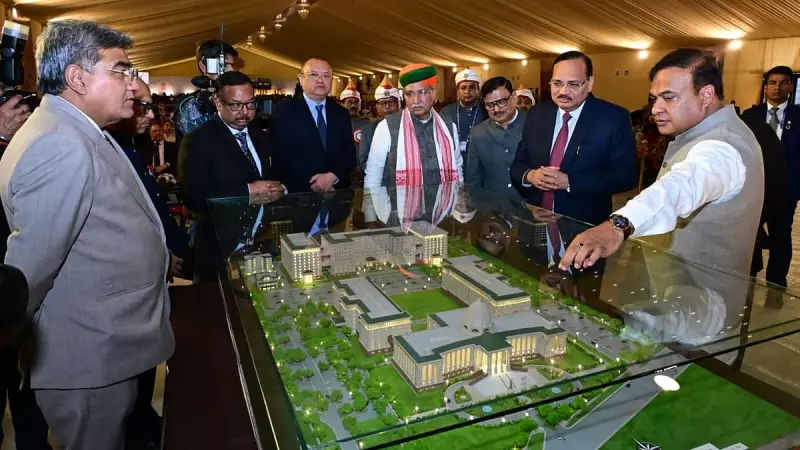
In a significant yet contentious development for Assam's judiciary, Chief Justice of India (CJI) Justice D Y Chandrachud laid the foundation stone for a new High Court complex in Guwahati on Saturday. The ceremony, held at the proposed site in Agratoli, Chandrapur area, was marked by a notable boycott from a section of lawyers and an ongoing hunger strike by an advocate, highlighting deep-seated disagreements over the chosen location.
A Ceremony Overshadowed by Protest
The foundation-laying event was attended by several dignitaries, including Assam Chief Minister Himanta Biswa Sarma, Union Law Minister Arjun Ram Meghwal, and Supreme Court judge Justice Surya Kant. Justice Kant, who is the executive chairman of the National Legal Services Authority (NALSA), also presided over a regional conference on access to justice for marginalized communities earlier in the day.
However, the official ceremony faced a stark contrast in sentiment from a segment of the legal fraternity. The Guwahati High Court Bar Association (GHCBA) had announced a boycott of the event, arguing that the Agratoli site is too distant and inconvenient. In a powerful act of protest, advocate Dharmakanta Deka continued an indefinite hunger strike, which he began on Friday, demanding the new complex be constructed within the city's Dispur area instead.

The Heart of the Dispute: Location and Accessibility
The core of the controversy lies in the selection of the Agratoli site. Lawyers opposing the move have presented a multi-faceted argument against it. They contend that the location, approximately 25 kilometers from the current High Court premises in Guwahati, would pose severe logistical challenges for thousands of lawyers, litigants, and court staff who commute daily.
Their demands are clear and specific. The protesting lawyers want the new complex to be built in Dispur, which houses the Assam Secretariat and is considered a more central and accessible part of the city. They have expressed fears that the remote Agratoli location could severely hamper access to justice, especially for citizens from distant parts of the state and those with limited means.
"The foundation stone has been laid, but the struggle is not over," a member of the protesting lawyers' group was quoted as saying, emphasizing their resolve to continue opposing the current plan.
Official Justifications and Future Implications
Despite the protests, government and judiciary officials have defended the Agratoli project. They cite the need for a modern, spacious, and technologically advanced High Court complex to accommodate the growing needs of the judiciary in the northeastern region. The current building is reportedly congested and lacks adequate infrastructure for the future.
During the ceremony, CJI Chandrachud emphasized the importance of creating inclusive and accessible judicial infrastructure. The new complex is envisioned as a state-of-the-art facility that would serve the people of Assam and the Northeast for decades to come. The event also saw the release of a commemorative postal stamp to mark the occasion.
The clash between the judiciary's vision for modern infrastructure and the legal community's practical concerns over accessibility now sets the stage for continued dialogue, or potentially further agitation. The hunger strike by Advocate Deka adds a layer of urgency to the situation, raising questions about how the authorities will address the lawyers' grievances while moving forward with the construction plans. The outcome of this standoff will significantly impact the daily functioning of justice delivery in Assam and shape the future of its judicial landscape.