
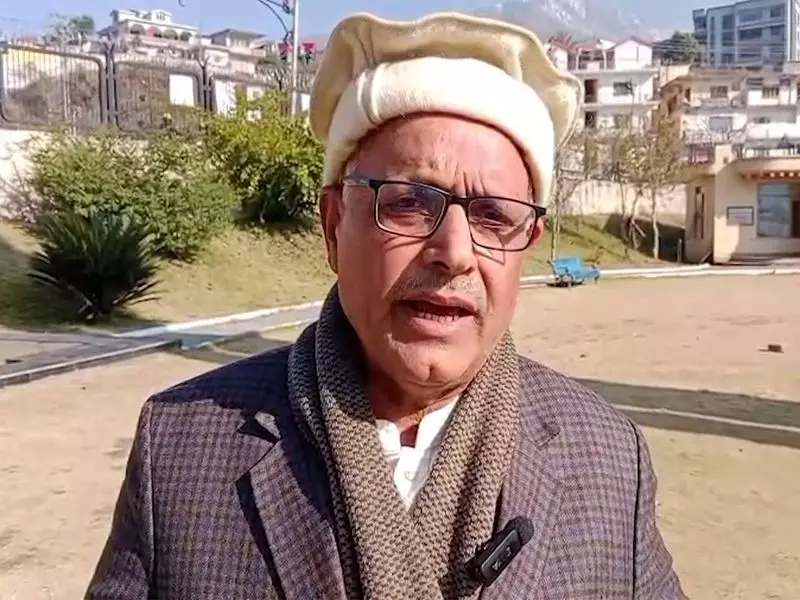
A prominent legal expert from Pakistan-occupied Jammu and Kashmir (POJK) has launched a sharp critique against the federal government in Islamabad. He accuses it of actively undermining the region's legislative assembly to shield the privileges of a powerful elite. The allegations point to a deep constitutional conflict over who holds real power in the disputed territory.
Core Allegations: Federal Overreach and Elite Protection
The lawyer, Sardar Tajammul Islam, presented his arguments before the Islamabad High Court. His central claim is that the federal government is illegally preventing the POJK assembly from amending its own interim constitution, known as the POJK Interim Constitution Act 1974. This, he argues, is a direct attack on the assembly's authority.
Islam contends that the federal bureaucracy, particularly through the Ministry of Kashmir Affairs and Gilgit-Baltistan (KGB), is overstepping its bounds. He states the ministry is acting as a "supra-constitutional authority" by controlling the assembly's agenda and blocking proposed legislation. The goal of this interference, according to the lawyer, is clear: to maintain the status quo that benefits a select group. "The federal government is protecting the privileges of the elite and powerful," Islam asserted in court.
The Gilgit-Baltistan Order and a Precedent of Control
To support his case, Islam drew a parallel with another region under Pakistan's administration: Gilgit-Baltistan (GB). He referenced the Gilgit-Baltistan Order of 2018, which he described as a tool that effectively stripped the GB assembly of its sovereign legislative powers. The order granted extensive authority to the federal government, reducing the local assembly's role.
The lawyer warned that a similar fate could befall the POJK assembly if the federal interference is not checked. He argued that the POJK council, a body headed by the Pakistani Prime Minister, is being used to bypass the elected representatives in Muzaffarabad. This creates a system where the real power lies not with the local populace's elected officials but with federal appointees in Islamabad.
Legal Battle and Implications for Governance
The court hearing, presided over by Justice Sardar Ejaz Ishaq Khan, is part of a larger petition. This petition challenges the very legal framework governing POJK, specifically the 2018 amendments to its interim constitution. The proceedings have been adjourned until September 24, when the arguments will continue.
This legal confrontation highlights a significant tension in the governance of POJK. On one side stands the principle of local representation and legislative autonomy for the region's assembly. On the other is the federal government's entrenched control over policy and administration. The outcome of this case could redefine the balance of power and either reinforce or weaken the influence of federal institutions in the daily affairs of the territory.
The allegations raise serious questions about democratic representation and constitutional rights in POJK. If the assembly's power to legislate is being systematically curtailed by Islamabad, it suggests that the region's political fate remains tightly controlled from the outside, limiting self-governance for its inhabitants.