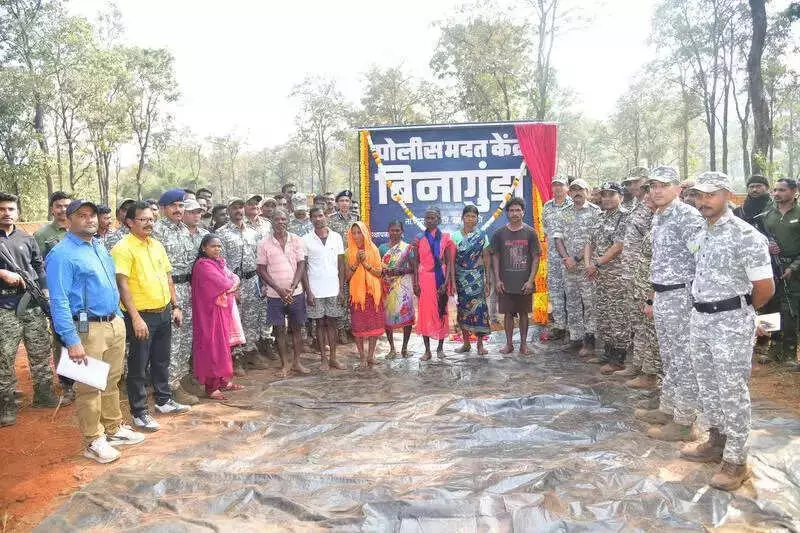
Historic Police Revival in Maharashtra's Remote Binagunda Village
In a landmark security operation, Maharashtra's elite C-60 commandos have successfully reinstated police presence in the picturesque village of Binagunda, located deep within the dense Abujmarh forests. This strategic move comes after a gap of three decades, marking a significant milestone in the state's efforts to secure the region that was once part of the now-dismantled Red Corridor.
Overnight Operation and Strategic Importance
The new police outpost was established through a meticulously planned 24-hour operation involving over 1,000 security personnel. These forces first constructed an 18-kilometer road from Laheri in Gadchiroli district to access the high-altitude location, which offers a commanding vantage point for surveillance and operations. This positioning is crucial for flushing out remaining guerrilla elements as authorities work toward a March 31 deadline for enhanced security measures.
Binagunda, often referred to as the 'Kashmir of Vidarbha' due to its challenging terrain featuring steep climbs, cascading waterfalls, lush green valleys, and misty hills, had long been enveloped in fear with zero tourist activity. Similar to security challenges faced in Kashmir despite scenic beauty, this area witnessed explosives destroying government installations and sustained attacks on security forces until Saturday's breakthrough.
Infrastructure Development and Economic Prospects
The newly established police post is expected to facilitate the construction of National Highway-130D, which will connect Allapalli in Maharashtra with Narayanpur in Chhattisgarh, traversing the dense Abujmarh forests. A critical 27-kilometer missing link from Laheri to Kuwakodi on this highway is slated for completion soon, potentially triggering an economic transformation in these once-forbidden hills.
Currently marooned for six months during monsoon seasons, the area will soon benefit from bridges over nullahs, making it motorable year-round. This infrastructure development promises to unlock new opportunities for local communities and businesses.
Historical Context and Previous Challenges
Sources reveal that a police post was initially opened in Binagunda in 1996 but had to be abandoned following relentless guerrilla attacks. The extreme inaccessibility of the location is evident from the steep elevation climb from 285 meters at Laheri police post to 585 meters at Binagunda over just 18 kilometers, compounded by the area being a heavily booby-trapped Maoist stronghold.
A tragic reminder of the region's volatility occurred in 2009 when at least 17 policemen lost their lives in an ambush at Laheri, located just 20 kilometers from Binagunda.
Current Challenges and Technological Solutions
The revived police post faces formidable obstacles including:
- Absence of paved roads
- Erratic power supply supplemented by only two generators
- No mobile network coverage
- Limited wireless communication capabilities
The sole lifeline for security forces currently is satellite-based internet connectivity via Eutelsat, enabling minimal contact with family members alongside essential communication through satellite phones.
Transformation and Future Vision
On Saturday, this serene enclave emerged from decades of isolation and conflict, creating pathways for development and enhanced security. According to SP Gadchiroli Neelotpal, the establishment accelerates road construction, improves power supply, and opens opportunities for eco-tourism that could transform the area into a thriving tourist destination.
The inauguration ceremony was attended by key officials including IG anti-national operation cell chief Sandeep Patil, DIG Ankit Goyal, CRPF battalion commandant Shambhu Kumar, Additional SP (Operations) M Ramesh, Additional SP Aheri Karthik M, and Additional SP Admin Gokul Raj, along with 300 local tribal representatives. This marks the tenth police post opened in Gadchiroli district.
Electricity, which was introduced to the area for the first time since Independence in 2023, currently lasts barely three months before monsoon disruptions, highlighting the ongoing infrastructure challenges that need addressing.