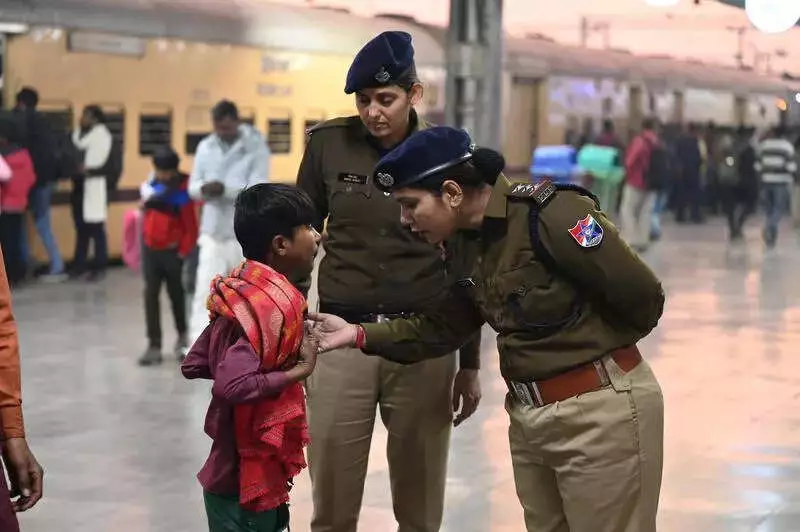
Railway Inspector's Quiet System Rescues Over 1,500 Missing Children
Every single week, children vanish from railway stations across Uttar Pradesh. They disappear for many reasons. Some simply get lost in the massive crowds. Others are led away by human traffickers. Many are coaxed onto trains with false promises of work. A few are running from situations they cannot even describe.
For the past three years, Railway Protection Force Inspector Chandana Sinha has led a remarkable effort to find them. Her work has resulted in the rescue of more than 1,500 children across the state's extensive rail network. In 2024 alone, her dedicated team intercepted 494 children. This number included 41 who were confirmed victims of labor trafficking. Inspector Sinha personally rescued 152 of these children herself.
Highest Honor and an Immediate Return to Duty
In recognition of this extraordinary service, Indian Railways awarded Chandana Sinha its highest service honor. She received the Ati Vishisht Rail Sewa Puruskar at a formal ceremony in Delhi on January 9. The award did not celebrate just one heroic act. Instead, it recognized a complete system she built from the ground up.

Hours after receiving the prestigious award, Inspector Sinha was back at work in Lucknow. A new report had already arrived. A child was seen sitting alone on Platform 3 of Charbagh station, and the system she created immediately swung into action.
Building a System from Scratch
Sinha, who leads operations from Lucknow's busy Charbagh station, began without any official blueprint. Her work started with isolated interventions. She would help one missing child or question one suspicious passenger. From these small acts, a powerful method slowly emerged.
She developed a multi-layered approach. She trained her officers to read the subtle signs on crowded platforms. She built a confidential network of informers. She established discreet partnerships with non-governmental organizations. Most importantly, she created a fast-moving protocol that operates without drawing attention.
Her techniques sharpened during a brief posting at New Delhi Railway Station in 2022. During the chaotic Chhath Puja crowd, she spent two hours searching for a missing woman and her three-year-old son. She finally found them sitting quietly on a bench, unharmed but invisible to the hundreds of people who had walked right past them. That experience, she later said, permanently changed what she looked for in a crowd.
Leading Operation Nanhe Farishte
In June 2024, her expertise led to a major appointment. Indian Railways asked her to lead Operation Nanhe Farishte, the national railway's dedicated child rescue initiative. Her unit, composed mostly of women officers, began intercepting children on known trafficking routes from Bihar to Punjab and Haryana.
Many rescued children are between 13 and 15 years old. They are often found traveling with strangers. "They're told they'll get work, but most don't even know what kind of job it will be," Sinha explained. "The traffickers are often just the middle link in a larger chain."
The Art of Observation and Patient Rescue
Rescues rarely begin with a formal tip. They start with an officer's sharp observation. It could be a child's posture, an unusual silence, or a particular look in their eyes.
"We look for a child sitting completely alone. We notice someone standing too close. We see a face that looks scared or completely blank," Sinha described. "The key is spotting the mismatch between the child and the people they are with."
Once a child is intercepted, the real work begins. It can take hours to get a child to speak. Some stay completely silent. Others repeat a memorized script given to them by traffickers. Her officers learn to wait patiently.
In one difficult case, her team found a 15-year-old girl who had run away with a man twice her age. The man fled as soon as officers began asking questions. It then took several hours to persuade the frightened girl to go to a Childline support centre. "She said she wasn't going back home," Sinha recalled. "But she also didn't know where else to go."

Reuniting children with their families, especially girls, presents its own challenges. "Sometimes the parents plead with us not to register an official case," Sinha said. "They are worried about family honor and social stigma. We have to counsel the parents just as carefully as we care for the child."
A Model That Works
The results speak for the system's effectiveness. In 2025, her team rescued an impressive 1,032 children. This group included 39 trafficked for labor and one scared six-year-old girl.
Senior Divisional Security Commissioner Devansh Shukla said Sinha's methods have become a model for others. "She's built a team that works on familiarity," Shukla noted. "It's not about aggressive surveillance. It's about a constant, caring presence. She has officers who know exactly what to look for. She has informers who know what information is important to share."
Much of this child protection work falls outside the RPF's original mandate, which focused on railway property and general passenger safety. However, under Operation Nanhe Farishte and broader anti-human trafficking initiatives, Sinha's team now works closely with NGOs and district authorities. They build detailed records that often help children long after a single train journey has ended.
Praise from Child Rights Partners
Deshraj Singh, a project coordinator with the Association for Voluntary Action, part of the Bachpan Bachao Andolan, praised Sinha's commitment. "Most RPF units were not originally designed for this kind of sensitive, child-focused work," Singh said. "But Chandana has made it a clear priority. She has taken personal ownership of this mission in a way that is rarely seen within large government systems."
The Woman Behind the Uniform
Chandana Sinha is 41 years old. She grew up in Bilaspur, Chhattisgarh, where her father was a government employee. She joined the Railway Protection Force in 2010 after years of dedicated preparation.
Her inspiration came from an unexpected source. She was deeply inspired by the 1980s television series Udaan, which was based on the life of IPS officer Kalyani Singh. "That story stayed with me," Sinha reflected. "It was the first time I saw a woman wearing a uniform and taking charge. It showed me what was possible."
Throughout her career, she has served at the Railway Board, trained other officers, and handled desk roles. She is famously camera-shy and actively avoids the spotlight. She has attempted examinations for higher ranks without regret, focusing always on her current duty. "Whatever work is given to me, I do it fully and with my whole heart," she stated simply. She is also a mother to an 11-year-old daughter, balancing her demanding professional life with her family responsibilities.