Rajasthan High Court Grants Statutory Bail to Juvenile in POCSO Case, Orders Probe into Record Discrepancies
The principal bench of the Rajasthan High Court in Jodhpur has granted statutory bail to a juvenile suspect arrested in a Protection of Children from Sexual Offences (POCSO) case. The court ruled that his detention beyond 90 days without a chargesheet constituted a clear violation of his fundamental right to personal liberty.
Chronological Impossibility in Case Records
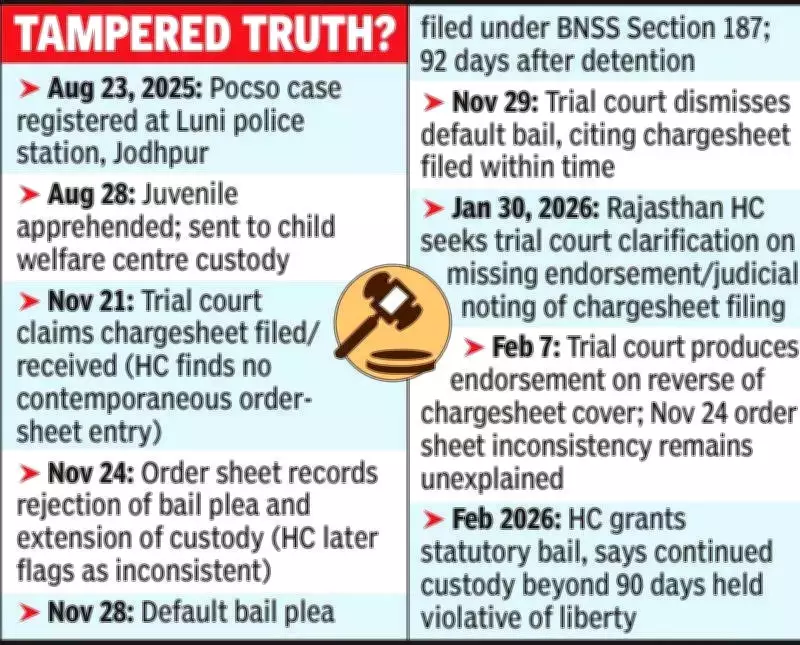
Justice Farjand Ali, presiding over the case, also directed an independent investigation into what he described as a "chronological impossibility" within the official case documents. The judge highlighted a specific order sheet dated November 24, 2025, which recorded that a trial court had rejected the juvenile's bail plea and extended his remand.
Justice Ali pointed out a critical flaw: this judicial order could not logically precede the event it was documenting. The bail application itself was not filed until November 28, 2025, and was dismissed the following day, November 29. This created an inexplicable timeline that the court could not overlook.

Background of the Case and Detention
The juvenile suspect was originally arrested on August 28 of the previous year in connection with a case registered at the Luni police station in Jodhpur. Following his arrest, he was held at a child welfare centre. A plea for default bail under Section 187 of the Bharatiya Nagarik Suraksha Sanhita (BNSS) was filed 92 days into his detention, arguing that the mandatory chargesheet had not been filed within the 90-day period.
The trial court rejected this bail plea, asserting that the chargesheet had indeed been filed on November 21—within the prescribed timeframe. However, the High Court found "no contemporaneous order sheet" to substantiate this claim, casting serious doubt on the official chronology presented.
Survivor's Statement and Lack of Direct Allegation
Adding another layer of complexity to the case, Justice Ali noted that in her statement before the special POCSO court on January 9, the survivor did not directly attribute any specific role in the crime to the juvenile suspect. Instead, she named only his co-accused as the perpetrator of the alleged sexual assault that resulted in her pregnancy.
High Court's Inquiry and Judicial Response
Seeking to resolve these mounting discrepancies, the High Court, on January 30, formally asked the trial court to explain the absence of any judicial record confirming the filing of the chargesheet. The presiding officer of the trial court responded on February 2, citing staff shortages as the reason for the delay in documentation.
A further clarification requested on February 4 yielded, three days later, an endorsement on the reverse of the chargesheet cover. Despite this, the fundamental chronological inconsistency pertaining to the November 24 order sheet remained completely unexplained and unresolved.
Court's Ruling and Emphasis on Judicial Integrity
Justice Ali held that these discrepancies could not be dismissed as mere typographical errors, especially given that a juvenile's personal liberty was at stake. In granting bail to the boy, the judge emphasized the gravity of the situation.
The court ordered an independent fact-finding inquiry into the alleged irregularities in the case records. While stopping short of drawing immediate conclusions about the intentions of the judicial officer involved, Justice Ali issued a stern warning. He stated that any fabrication or post-facto creation of judicial records would "strike at the very root of judicial integrity," undermining public trust in the legal system.
This ruling underscores the judiciary's role in safeguarding procedural fairness, particularly in sensitive cases involving minors, and reinforces the principle that liberty cannot be curtailed without strict adherence to due process.