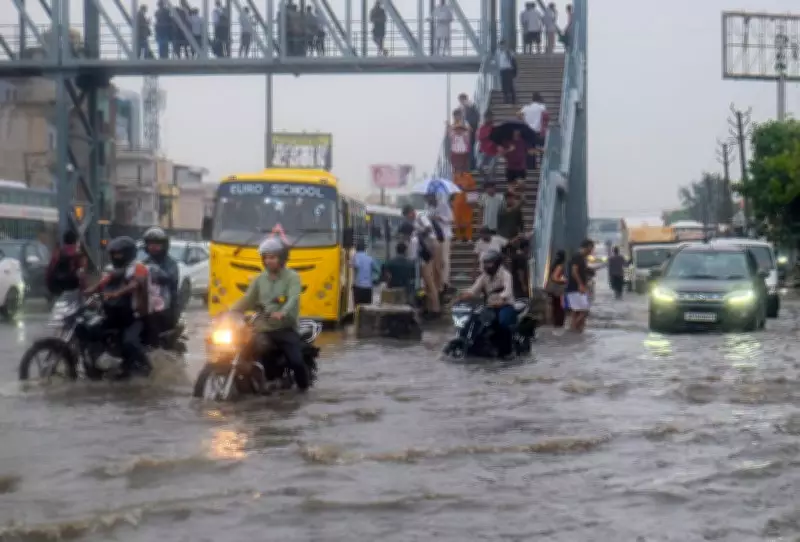
Gurugram, the corporate capital of India, once again came to a standstill this week after receiving 115 mm of rain in 33 hours, with 83 mm falling on Tuesday alone. The deluge submerged over 50 critical intersections and residential areas, paralyzing traffic and stranding commuters for hours. This recurring crisis highlights the persistent failure of civic infrastructure despite the expenditure of approximately Rs 1,400 crore over the past decade on drainage upgrades and maintenance.
Decade of Spending, Recurring Flooding
Since the infamous 'Gurujam' of 2016, which brought the city to a 20-hour halt, civic authorities have allocated substantial funds to improve the drainage network. In 2018, then Haryana Chief Minister Manohar Lal Khattar announced a comprehensive overhaul to connect old and new Gurugram and restore natural stormwater drains. However, key projects like a Rs 280-crore plan to build 20 check dams and 200 recharge wells remain largely unimplemented.
Instead, over Rs 700 crore has been spent on temporary measures such as pumps and pothole repairs. The Municipal Corporation of Gurugram (MCG) alone spent Rs 503 crore over nine years on sewer repairs. Despite these efforts, the city remains vulnerable to waterlogging during heavy rainfall.

This Week's Crisis: 115 mm in 33 Hours
This week's rainfall—83 mm on Tuesday and 32 mm on Wednesday—caused widespread disruption. A 10-foot-deep crater appeared on the NH-48 expressway near Narsinghpur where the Gurugram Metropolitan Development Authority (GMDA) was laying stormwater pipes. The cave-in triggered an 8-km-long traffic jam that lasted late into the night. Commuters took nearly two hours to travel just 5 km, app-based taxis were scarce, and some motorists abandoned their vehicles to walk home through flooded streets.
Affected areas included Sheetla Mata Road, Sector 9, Khandsa Road, Sectors 31, 45 and 57, and Sohna Road. Schoolchildren were stuck in buses for up to five hours without food. In Feroze Gandhi Colony, a cyclist and a cow fell into separate open sewer pits.
GMDA Defends Response
Amid public anger, GMDA Chief Executive Officer PC Meena defended the administration, claiming the city handled the situation better than in previous years. “The city received over 80 mm of heavy rain in just three hours. Because of Gurugram’s terrain and some low-lying areas, a large amount of surface runoff is unavoidable. However, water was drained out within 30 minutes to two hours, depending on the location. No underpass was flooded, major vulnerable points remained clear and there were no casualties. We expect to improve further during the next spell of rain,” Meena said.
He highlighted that major investments, such as the Rs 453-crore Khandsa drain-widening project (which increased bottleneck capacity from 500 to 1,400 cusecs) and the newly built Rs 105-crore Leg-4 parallel drain, were finally yielding results.
Conclusion: Infrastructure Gap Persists
Despite the assurances, the annual monsoon crisis in Gurugram underscores a significant gap between government spending and effective outcomes. With over 50 areas still vulnerable and key projects pending, residents and commuters continue to bear the brunt of inadequate urban planning.