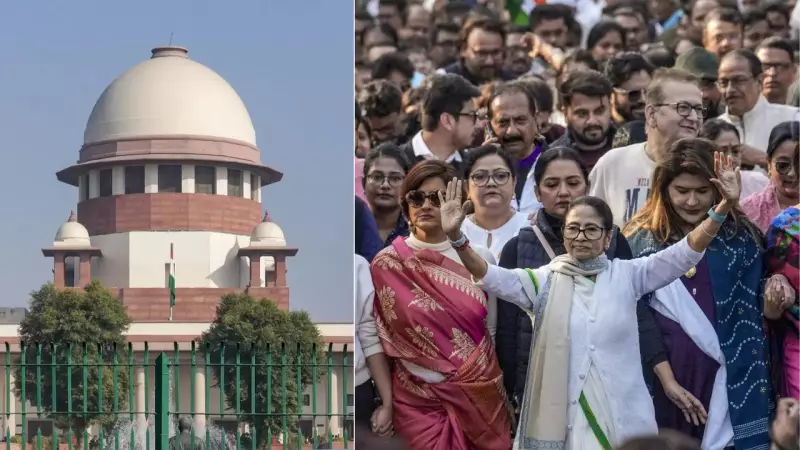
Supreme Court Voices Concern Over Calcutta High Court Disruption
The Supreme Court of India made its position clear on Thursday. The court stated it felt deeply disturbed by the chaotic scenes witnessed at the Calcutta High Court on January 9. This disorder directly led to the adjournment of a crucial hearing. The hearing concerned an Enforcement Directorate (ED) plea against the Mamata Banerjee-led West Bengal government. The plea related to recent raids conducted on the Indian Political Action Committee (I-PAC).
Court Questions If High Court Became a Protest Site
Reacting strongly to the events, the Supreme Court bench questioned the nature of the gathering. The central agency, the ED, had charged that the Trinamool Congress (TMC) instructed people to attend. In response, the SC remarked whether the high court had turned into a protest ground similar to Jantar Mantar in Delhi. Justice Mishra pointedly asked, "Come everyone? As if it's Jantar Mantar!"
Solicitor General Tushar Mehta presented the ED's case before the bench. He described the situation as one where "mobocracy replaces democracy." Mehta submitted that the high court's own records supported this view. He placed alleged WhatsApp chats from the ruling party's legal wing on record. According to him, these chats showed the gathering was not spontaneous. People were allegedly instructed by the party's legal cell to go to the court.

Allegations of Organized Transport and Disrupted Proceedings
The Solicitor General provided further details about the January 9 incident. He claimed that buses and other vehicles were arranged specifically to ferry people to the high court. Prior to the hearing, the acting chief justice had issued an administrative order. This order restricted the entry of unauthorized persons into the courtroom. Despite this, the proceedings faced significant disruption.
Mehta informed the court that the hearing was live-streamed. He described the session as "less than satisfactory." The ED faced numerous difficulties during their submissions. Notably, the microphone was constantly muted, hindering their arguments. When advocate Kapil Sibal began his submissions on behalf of Mamata Banerjee, the bench reiterated its concern. Justice Mishra stated, "We are disturbed by the manner in which the hearing in the High Court was last week adjourned due to commotion."
High Court's Own Record and Supreme Court's Actions
The Solicitor General suggested the courtroom gathering might have been intentional or unintentional. The judge responded by emphasizing the high court's official record. Justice Mishra noted, "intentional or not, the high court has recorded something." The high court itself had adjourned the matter, citing commotion as the reason in its records.
The Calcutta High Court proceedings were indeed adjourned on January 9. The chaos disrupted the hearing concerning both the ED's I-PAC matter and the Trinamool Congress's counter-petition.
Supreme Court Takes Serious View of Allegations
The top court termed the ED's allegations as "very serious." The agency claimed that Mamata Banerjee obstructed its investigation. The court stated it would examine a fundamental question. It will determine whether state authorities can lawfully interfere with probes conducted by central agencies in serious cases.
Taking immediate action, the Supreme Court issued specific orders. It stayed the FIR filed by the West Bengal police against ED officials. The court also directed that CCTV footage from the January 8 raids be preserved securely. The ED had approached the Supreme Court after its officers allegedly faced resistance. This resistance occurred during searches at the I-PAC office and the residence of its director, Pratik Jain. The searches were part of a coal smuggling case investigation.
The ED made a specific claim against the Chief Minister. It alleged that Mamata Banerjee entered the premises during the raids and took away key evidence. Both the Chief Minister and the TMC have firmly denied this charge. They have instead accused the central agency of overreach and acting beyond its mandate.